

Armoloy Specifications
Armoloy Specifications
ASTM B571
Standard Practice for Qualitative Adhesion Testing of Metallic Coatings
Armoloy Specifications
What is ASTM B571?
This practice outlines eleven different qualitative tests, offering flexibility to manufacturers and inspectors depending on the base material, coating type, and part geometry. It applies broadly across metals, including but not limited to:
- Electroplated coatings like chromium and nickel
- Flame-sprayed coatings
- Vacuum-deposited films
- Conversion coatings
The standard plays a critical role in quality control, process validation, and material acceptance testing in industrial coating applications.
The Role of ASTM B571 in Chromium and Nickel Coatings
Chromium Coatings
Chromium coatings—especially thin dense chrome (TDC) and microcracked or nodular variations—are widely used in industries like aerospace, automotive, and injection molding due to their hardness, corrosion resistance, and wear properties. ASTM B571 is often used as a go/no-go test to confirm coating adhesion before or after thermal and mechanical stresses. Ensuring proper adhesion is vital because poor bonding can lead to:
- Flaking or spalling under mechanical loads
- Premature wear in sliding or rotating components
- Failure of critical parts, especially in aerospace or medical devices
ASTM B571 helps verify that the coating process—typically electroplating or PVD—is delivering a consistent and reliable bond to the substrate.
Nickel Coatings
Nickel plating, often used for corrosion resistance or aesthetic appeal, also benefits from ASTM B571 testing. Particularly in electroless nickel (EN) and electrolytic nickel applications, the standard helps evaluate the uniformity and bonding integrity of the deposit.
Poor adhesion in nickel coatings can result in blistering or delamination, especially when parts are subject to temperature cycling or chemical exposure. ASTM B571 tests such as the heat-quench or thermal shock methods can simulate these in-use conditions and flag process issues before failure occurs in the field.
ASTM B571 Testing Methodology & Results
ASTM B571 offers eleven qualitative tests, each designed to evaluate how well a metallic coating adheres to its substrate. The test used often depends on the substrate-coating combination, geometry, and end-use conditions. Common methods include:
- Bend Test
Bends the coated specimen over a mandrel or until a specific radius is reached.
Examines coating for cracks, flaking, or delamination. - Burnishing Test
Uses a smooth hard object to rub the coated surface.
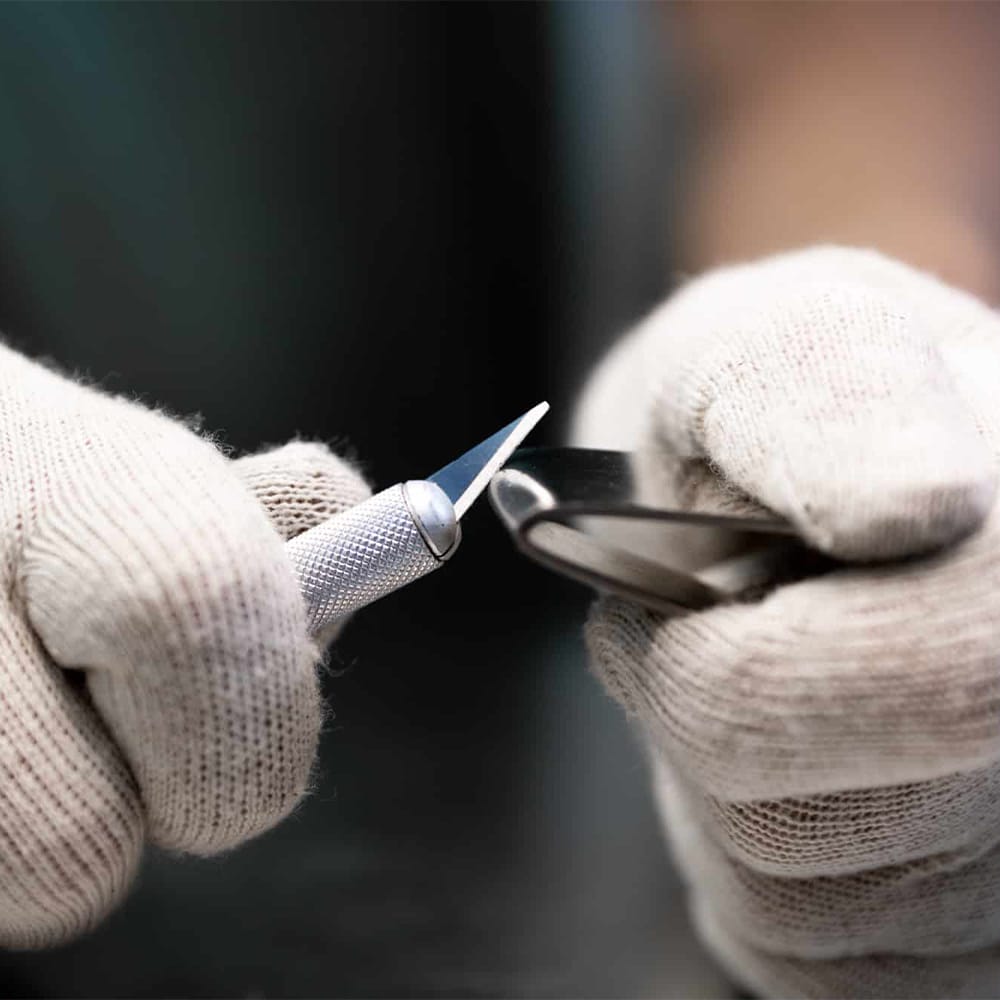
Poor adhesion shows as flaking or peeling. - Chisel-Knife Test
Involves cutting or chiseling into the coating.
Observes whether the coating peels or separates easily. - Thermal Shock or Heat-Quench Test
Heats the part and rapidly cools it.
Simulates service conditions for coatings used in engines or aerospace parts. - Scribe-Grid Tape Test
Cross-hatched grid is scribed through the coating.
Adhesive tape is applied and removed to see if any flakes lift off. - Impact Test
A weighted ball or punch strikes the coating.
Good adhesion resists cracking and separation around the impact site.
Interpreting Results:
ASTM B571 does not assign a numerical rating. Instead, results are interpreted qualitatively, with coatings classified as either:
- Adherent (Pass): No flaking, peeling, or delamination
- Non-adherent (Fail): Visible detachment or cracks
This pass/fail nature makes it useful for production line checks, coating process control, and supplier certification.

Industries that Use ASTM B571
ASTM B571 is recognized across a wide range of industries where coating performance is critical to functionality, safety, or longevity:
- Aerospace: Ensures high-performance coatings on turbine parts, landing gear, and fasteners remain intact under stress, pressure, and temperature changes.
- Automotive: Validates nickel or chrome coatings on transmission parts, pistons, and braking components.
- Medical Devices: Used for surgical tools and implants requiring biocompatible coatings like TDC or ME-92. Prevents contamination or flaking in the body.
- Oil and Gas: Confirms adhesion on parts exposed to corrosive fluids, pressure, and extreme temperatures.
- Food Processing: Ensures non-reactive coatings remain bonded on sanitary equipment, rollers, or molds.
- Semiconductors: Critical in preventing delamination of conductive coatings on fragile components.
Benefits of Working with an ASTM B571 Provider
Higher Reliability
Manufacturers following ASTM B571 are committed to quality assurance. This reduces failure rates, returns, and warranty issues—especially critical in regulated industries
Improved Process Consistency
By applying standardized testing, providers can fine-tune pretreatment, plating, and post-treatment steps for repeatable outcomes
Faster Qualification
Working with a provider familiar with ASTM B571 can expedite approvals for aerospace, medical, or defense contracts, where documentation and testing standards are mandatory
Risk Mitigation
ASTM B571 identifies potential issues early—before coated parts are placed into service—reducing risk in high-cost or high-liability applications

Specifications at Armoloy
Armoloy offers plating solutions that meet ASTM B571 to support both regulatory compliance and individual project needs. Explore common specifications and accreditations we work with and contact us to find the right solution for your application.
Disclaimer
The information provided on this page, including any descriptions, interpretations, or summaries related to ASTM B571, is offered solely by The Armoloy Corporation for general informational purposes. This content reflects Armoloy’s internal understanding and practical application of ASTM B571 within its own processes and does not constitute official or authorized guidance from ASTM International.
ASTM B571 is a proprietary standard developed and owned by ASTM International. Armoloy makes no claim to ownership of this specification and does not reproduce, quote, or distribute any protected content from the original document. References to ASTM B571 are made in accordance with fair use principles and are intended to illustrate Armoloy’s alignment with widely recognized testing methods for evaluating the adhesion of metallic coatings.
This content is not intended to substitute for the official specification, which should be obtained directly from ASTM International. Readers are strongly encouraged to consult the original standard and qualified professionals for definitive technical or compliance information.
The Armoloy Corporation makes no warranties, express or implied, regarding the accuracy, completeness, or applicability of this content and disclaims all liability for any reliance placed upon it. This disclaimer is subject to change without notice and does not create any contractual relationship or obligation.