
Often, when the goal is bidirectional thrust in minimal space. For large overturning moments, keep a second bearing for stiffness.
what you should know
what you should know
Four Point Contact Ball Bearing
Selection, Failures, Fixes & Coatings
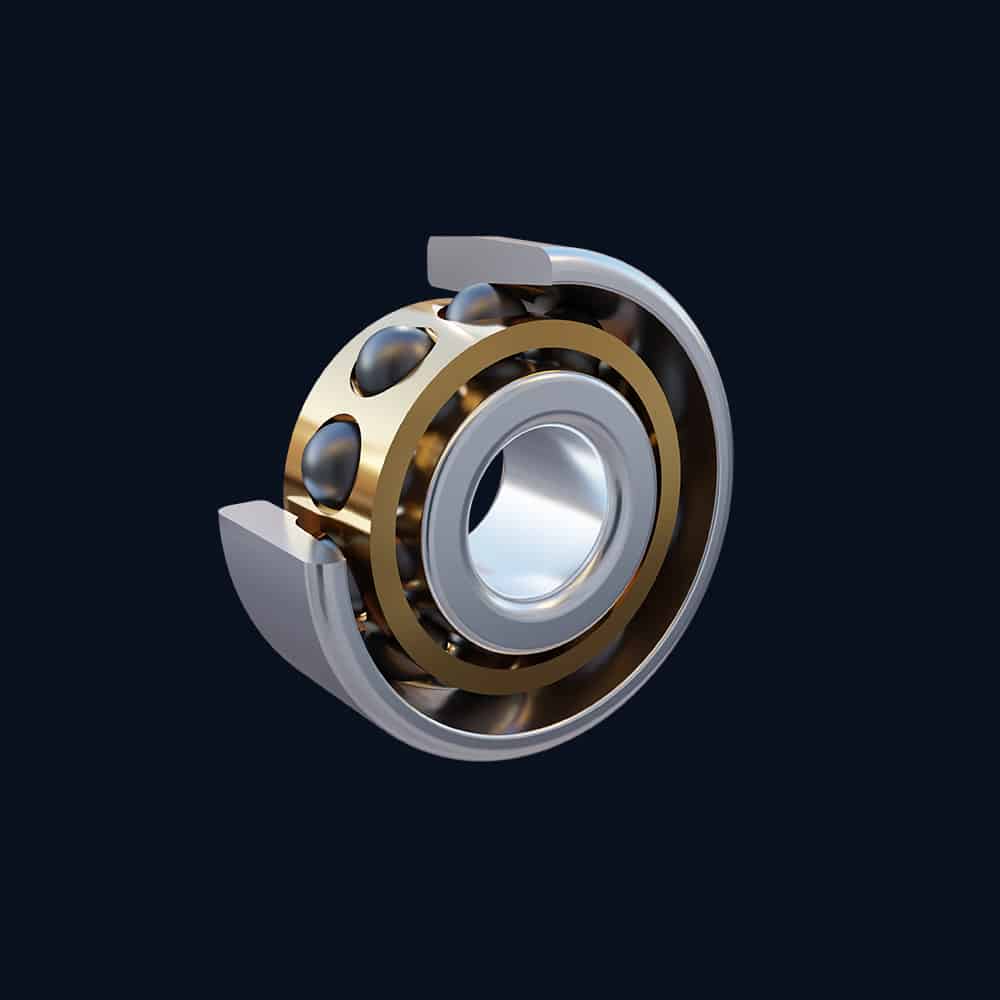
What Is a Four-Point Contact (QJ) Ball Bearing?
A single-row ball bearing with a large contact angle (≈35°) that can carry axial load in both directions plus radial load. QJ bearings are often used where a paired angular-contact set would normally be required, saving space and parts. They are not perfect moment bearings—pair with a second bearing when overturning moments are significant.
Typical uses: compact gearboxes, screw drives and actuators, turntables, compressors, light slewing rings, pumps, electric motor ends where bidirectional thrust is present.
Selection Cheatsheet (Load, Direction, Moment, Environment)
- Bidirectional thrust in limited space? QJ can replace an ACBB pair—confirm moment load is handled elsewhere.
- Moment present? Use a second bearing (radial or AC) spaced for overturning stiffness.
- Skidding risk? Avoid very light preload/clearance at high speed; ensure minimum radial load or preload.
- Environment: sealing/deflection first; choose lubricants for temperature and duty; treat surfaces when corrosion/fretting is the problem.
- After coatings: re-measure bore/OD/runout and **contact angle geometry**; small thickness changes can shift preload or seal gaps.
Environment → Attributes Matrix
| Environment | Material / Coating | Clearance / Preload | Fits (shaft / housing) | Sealing | Lubricant |
|---|---|---|---|---|---|
| Compact gearboxes | Through-hardened rings; optional wear/corrosion-resistant surfaces | Light preload or C0/C2; confirm no skidding | k5–m6 / H7; low runout seats | Shields or non-contact seals + gearbox sealing | Oil splash/jet per catalog viscosity @ temp |
| High speed (moderate thrust) | Low-roughness raceways; controlled thickness if coated | Light preload; maintain minimum radial load | Precision fits; balance and runout control | Low-drag shields/labyrinths | Low-bleed grease or oil (air-oil at very high dn) |
| Washdown / Food | Chromium-family or Ni-P (validated); stainless balls optional | C3 if interference/heat will reduce running clearance | k5–m6 / H7; verify post-coat geometry | Contact seals + deflectors; protect lips from jets | NSF H1 grease validated vs. cleaners & temp |
| Dusty / Abrasive | Hard, low-roughness surfaces; micro-textures optional | C3; avoid excessive drag from seals | Secure interference on rotating ring | Labyrinths + deflectors | Grease with sealing behavior; purge plan |
| Cleanroom / Vacuum | Clean, passivated surfaces; tight torque control | Light preload to keep torque low | Very low runout seats; minimal distortion | Non-contact shields; avoid elastomer outgassing | Low-outgassing grease or vacuum-rated oil |
Common Failures & Diagnostics
Rapid Triage

1) Misalignment / Edge Loading
Symptoms
Noise, heat, localized spalling near raceway edges.
Likely causes
Seat/runout errors, shaft/housing deflection, thermal distortion.
Checks
TIR/flatness; blue-check; thermal model; housing stiffness.
Non-coating actions
Improve flatness/parallelism; increase stiffness; correct alignment.
When surface treatments help
Secondary only—won’t fix geometry; can reduce scuffing once aligned.
2) Ball Skidding (light load, high speed)
Symptoms
Streaks/smearing; rising temperature; torque instability.
Likely causes
Insufficient preload/minimum radial load; low viscosity at temp.
Checks
Verify preload; calculate dn & viscosity @ operating temp; check cage.
Non-coating actions
Increase preload/min radial load; raise viscosity or move to oil/air-oil.
When surface treatments help
Low-roughness chrome can lower adhesion once film is adequate.
3) Preload Loss / Settlement
Symptoms
Backlash or axial float grows; noise on reversals.
Likely causes
Clamp relaxation; shim compression; thermal cycles.
Checks
Torque audit; axial play measurement hot vs. cold.
Non-coating actions
Re-set preload; improve clamp sequence; use harder shims.
When surface treatments help
May reduce seat fretting after clamp discipline is fixed.
4) Contamination / Abrasive Wear
Symptoms
Gritty feel, noise, accelerated wear.
Likely causes
Poor seals/deflectors; ingress during assembly; wash jets at seals.
Checks
Ingress routes; filter/cleanliness checks; seal lip condition.
Non-coating actions
Upgrade sealing/labyrinths; improve cleanliness; set purge/changes.
When surface treatments help
Hard chrome extends life after ingress is controlled.
5) Fretting / False Brinelling (idle vibration)
Symptoms
Reddish debris at seats; pitch-spaced dull marks; noisy start-ups.
Likely causes
Micro-motion with light preload; transport vibration; marginal film.
Checks
Transport profile; grease bleed; clamp integrity.
Non-coating actions
Stabilize transport; pick grease for idle vibration; confirm clamp.
When surface treatments help
Micro-textured chrome on seats reduces adhesion once motion is mitigated.
The Big Three: Corrosion, Lubricity, Dimensional Stability
Use coatings for surface-driven problems (corrosion, fretting, abrasion). They don’t replace correct fits, preload, or sealing.
| Concern | What it means | Non-coating controls (first) | When coatings help | Notes |
|---|---|---|---|---|
| Corrosion resistance | Prevent rust/pitting at raceways and shoulders | Seals/deflectors; manage wash jets; compatible grease/oil; dry-out | Thin dense chrome, micro-cracked chrome, Ni-P (validated) | Re-measure clearance/contact angle geometry after processing |
| Lubricity | Stable film at large contact angle under bidirectional thrust | Viscosity @ temp; maintain minimum radial load/preload; avoid over-sealing drag | Low-roughness or micro-textured chrome reduces smearing/skid onset | Coatings complement—not replace—lube and preload discipline |
| Dimensional stability | Hold runout/parallelism; keep seal gaps and preload in spec | Flat seats, torque pattern, thermal model | Controlled-thickness coatings; post-coat metrology | Thin sections & split rings are thickness-sensitive |
Fits, Tolerances & Preload (Quick Rules)
-
Rotating ring gets light interference (k5–m6) to prevent creep; stationary ring H7 slip for serviceability.
-
Misalignment budget ≈ small: keep seats flat/parallel; control runout to bearing precision.
-
Set preload or ensure minimum radial load at speed to avoid skidding.
-
After coatings: re-measure ID/OD, runout, and contact angle geometry; confirm seal compression.
Checklist
-
Seat flatness/parallelism verified
-
Preload/min radial load checked cold & hot
-
Seal strategy consistent with speed & drag
-
Post-coat geometry/runout measured
Frequently Asked Questions
More sensitive than deep-groove; similar to AC bearings—keep seats flat and runout low to avoid edge loading.
As light as possible for torque/heat, but enough to prevent skidding at speed. Validate by torque and temperature trends.
They can shift clearance and seal compression if thickness isn’t controlled. Measure geometry before/after processing.
Shielded versions exist; most sealing is at the housing level (labyrinths/deflectors or contact seals).
Case Snapshots
- Compact gearbox, bidirectional thrust — Wanted to remove AC pair for space.
Actions: switched to QJ + separate radial bearing; set light preload; oil viscosity sized @ temp.
Outcome: package shortened; temperature stable; no reversal clunk. - High-speed actuator skidding — Torque spikes at speed, streaks on raceway.
Actions: added minimum radial load; raised viscosity grade; reduced seal drag.
Outcome: torque trace smoothed; lower operating temperature.

Have a failure photo, sound clip, or spec?
Upload it for a no‑fluff diagnostic checklist. We’ll map symptoms → checks → next actions (and only propose coatings when they’re truly indicated).