
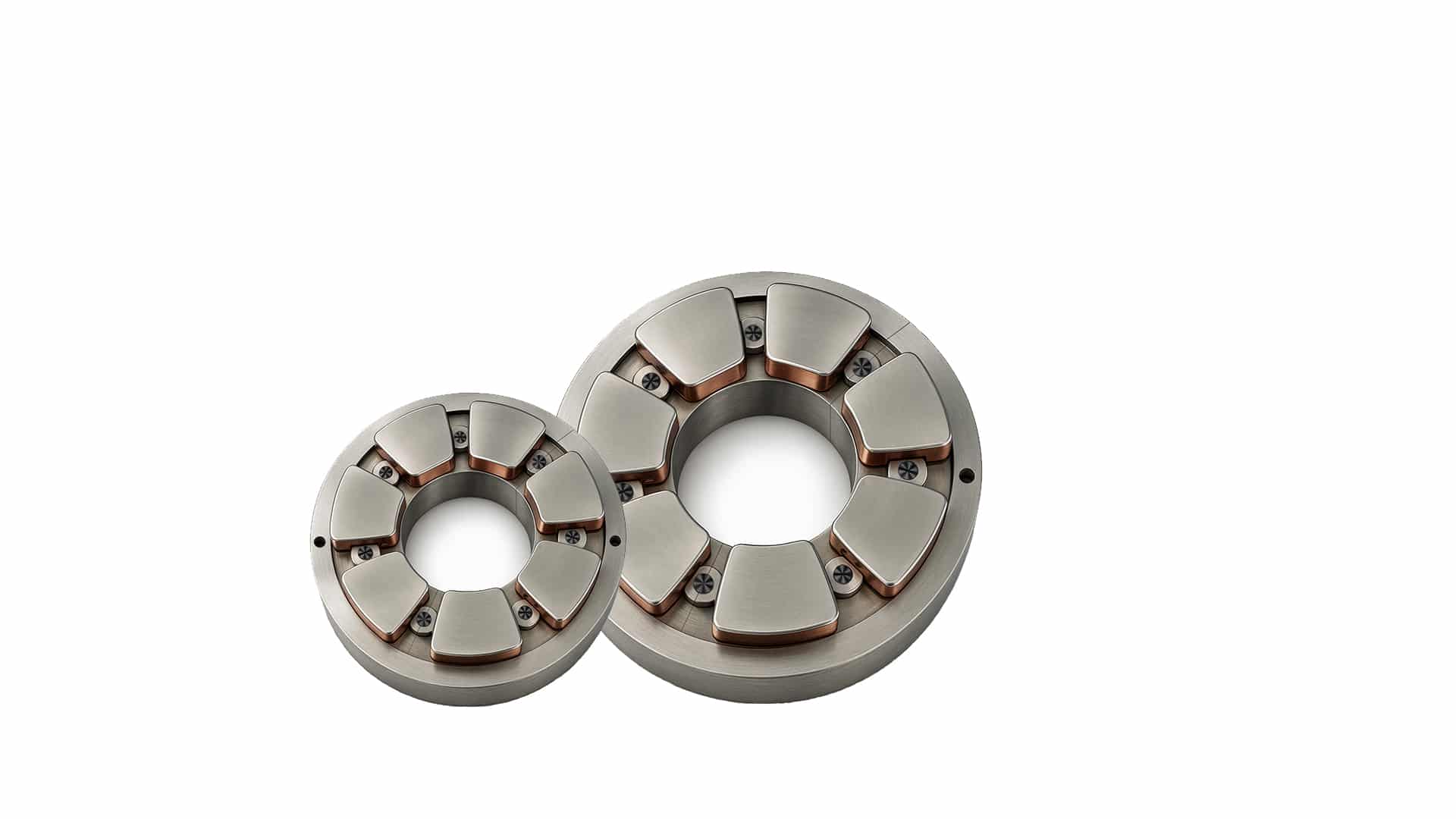
Hydrostatic (externally pressurized). Aerostatic gas also supports contact-free start if supply is on.
what you need to know
what you need to know
Fluid Bearings
Selection, Failures, Fixes & Coatings
What Is a Fluid Bearing?
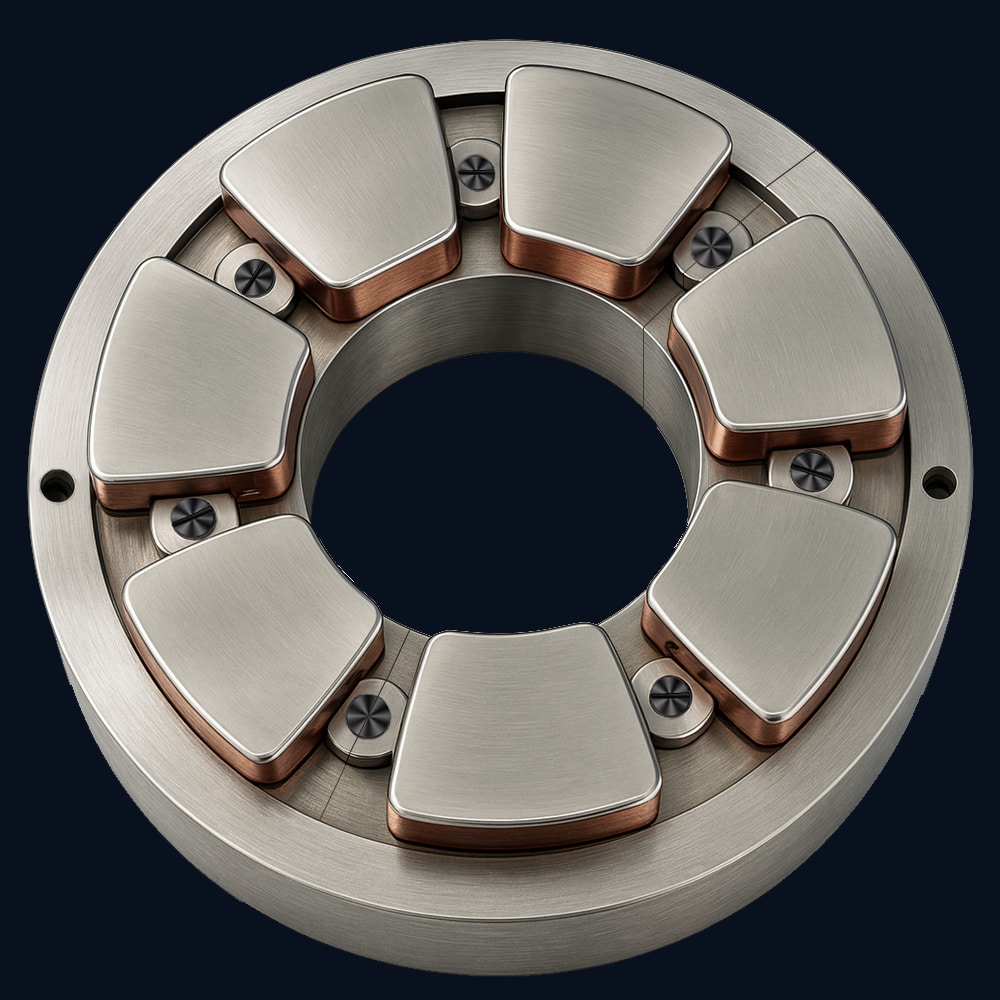
A bearing that supports load on a pressurized fluid film—oil, water, or gas—so the surfaces do not touch in normal operation. Families include hydrodynamic (film generated by motion), hydrostatic (film from external pump), and gas/air bearings (aerodynamic or aerostatic). Benefits: very low friction, high speed, excellent precision, and no wear when film is maintained.
Typical uses: turbomachinery (compressors, blowers), spindles & metrology stages, high-speed motors, paper/steel process rolls, machine tool slides, medical/food equipment (water-lubricated), cleanroom/vacuum motion systems.
Selection Cheatsheet (Duty, Film Source, Environment, Controls)
- Zero-speed load? Choose hydrostatic (externally pressurized) so the film exists before motion.
- Highest speed & cleanliness? Choose gas (aerostatic for start/stop, aerodynamic/foil for compact high speed).
- General industrial speed/load with robustness? Choose hydrodynamic (journal/thrust, tilting-pad for stability).
- Environment drives materials: water/food → stainless + inert coatings; vacuum/cleanroom → low-outgassing surfaces.
- Controls before coatings: supply pressure/flow, viscosity @ temp, filtration, thermal management, alignment/flatness.
- After coatings: re-measure IDs/ODs/flatness/groove geometry; verify lift-off speed, stiffness, and leakage.
Fluid Bearing Types — Quick Comparison
| Type | How the film is made | Pros | Watch-outs | Typical uses |
|---|---|---|---|---|
| Hydrodynamic (journal/thrust, incl. tilting-pad) | Wedge film from relative motion & viscosity | Simple hardware, good damping, high speed capability | Start/stop rub; viscosity @ temp critical; stability/whirl at certain loads | Turbomachinery, large rolls, motors, gearboxes |
| Hydrostatic (externally pressurized) | Pump supplies pressure to recesses; film exists at zero speed | High stiffness/accuracy; excellent low-speed behavior | Pumps/controls, power & heat; contamination-sensitive | Precision spindles/tables, heavy machine tools, metrology |
| Gas (aerostatic) | External compressed air through orifices/porous media | Contact-free start; clean; ultra-low friction/torque | Lower damping; high air cleanliness need; stiffness depends on supply | Semiconductor/inspection stages, precision rotary tables |
| Gas (aerodynamic/foil) | Self-generated film at speed; compliant foils support start/stop | High speed; compact; no external supply needed | Start/stop rub on foils; heat; materials compatibility | Blowers, microturbines, high-speed fans |
| Water-lubricated | Hydrodynamic or hydrostatic with water as the fluid | Food/biocompatible; low environmental impact | Corrosion risk; low viscosity → lift & heat challenges | Pumps, food processing, marine shafts |
Common Failures & Diagnostics
Rapid Triage

1) Loss of Film / Rub (start/stop or starvation)
Symptoms
Temperature spikes, metal transfer, discoloration, rising torque.
Likely causes
Insufficient supply pressure/flow, low viscosity at temp, delayed pump start, purge air wet/oily.
Checks
Pressure/flow logs; viscosity vs. operating temp; lift-off speed; start sequence timing.
Non-coating actions
Raise supply pressure/flow; increase viscosity or cooling; interlock pump start before motion.
When surface treatments help
Low-roughness or solid-lube-friendly surfaces can reduce start damage but won’t fix low supply.
2) Contamination (particles, water, air entrainment)
Symptoms
Noise/torque ripple, pad/journal scoring, shortened life.
Likely causes
Poor filtration, seal failures, improper handling, aerated oil.
Checks
ISO cleanliness codes; filter ΔP; de-aeration efficacy; seal inspection.
Non-coating actions
Upgrade filters/strainers; improve seals; air removal; maintenance discipline.
When surface treatments help
Hard, inert chrome resists abrasion/corrosion once ingress is controlled.
3) Thermal Runaway / Viscosity Collapse
Symptoms
Escalating temperature, loss of stiffness, whirl/instability.
Likely causes
Too low viscosity at temp; inadequate cooling; excessive load/speed.
Checks
Oil temp control; viscosity index; heat balance; rotor balance.
Non-coating actions
Increase viscosity or reduce temperature; improve cooling/flow; verify alignment and balance.
When surface treatments help
Not primary—thermo-hydrodynamics first.
4) Gas Bearing Instability (subsynchronous whirl)
Symptoms
Vibration at sub-synchronous frequencies; position error on stages.
Likely causes
Low damping; high cross-coupled stiffness; supply pressure variation.
Checks
Spectrum analysis; supply pressure stability; stiffness modeling.
Non-coating actions
Add damping (squeeze film/tilting pads), tune orifices, increase preload, stabilize supply.
When surface treatments help
Secondary—stability is a system property.
5) Water Chemistry / Corrosion Attack
Symptoms
Rust staining, pitting, roughness growth, torque rise.
Likely causes
Chlorides/pH out of range; stagnant water; incompatible materials.
Checks
Water quality logs (pH, chlorides); flow; dry-out procedure after washdown.
Non-coating actions
Correct chemistry; ensure circulation/dry-out; upgrade seals/deflectors.
When surface treatments help
Hard, inert chrome or Ni-P improve corrosion resistance on journals/pads.
The Big Three: Corrosion, Lubricity, Dimensional Stability
Apply coatings when they address surface-driven mechanisms (corrosion, fretting, abrasion) on journals, thrust pads, or housings. Coatings don’t replace supply pressure/flow, viscosity control, filtration, or alignment.
| Concern | What it means | Non-coating controls (first) | When coatings help | Notes |
|---|---|---|---|---|
| Corrosion resistance | Protect journals/pads & housings from water/chemicals | Seal strategy; chemistry control; de-aeration/drying | Thin dense/micro-cracked chrome or Ni-P (validated) | Check food/biocompatibility; re-measure geometry |
| Lubricity | Stable film, low start/stop friction (hydro + gas) | Viscosity @ temp; supply pressure/flow; filtration | Low-roughness or micro-textured chrome; solid-lubricant topcoats for foil starts | Coatings complement—not replace—fluid film formation |
| Dimensional stability | Hold clearances, flatness, and groove geometry | Thermal control; alignment; controlled assembly torque | Controlled-thickness coatings; post-coat metrology | Tiny thickness shifts change lift-off, stiffness, leakage |
Mounting, Supply & Geometry (Quick Rules)
-
Flatness/parallelism first: film thickness is microns—seat errors kill stiffness.
-
Supply interlocks: ensure pump/air supply is on and stable before motion; monitor pressure/flow.
-
Viscosity @ temperature: size for operating film; manage heat and de-aeration.
-
After coatings: re-measure IDs/ODs/flatness/grooves; verify lift-off speed and leakage.
Checklist
-
Seat flatness/parallelism verified
-
Supply pressure/flow interlocked & logged
-
Filtration & de-aeration validated
-
Post-coat metrology complete
Frequently Asked Questions
The wedge film forms only once there’s relative motion; select materials/coatings that tolerate brief rubs.
They can. Thickness and roughness shift film thickness, stiffness, and leakage. Measure geometry and validate lift-off after processing.
They can have high stiffness and low damping—address via design (tilting pads/squeeze film), supply stability, and structure.
Yes—validate materials/coatings for corrosion/biocompatibility, and control water chemistry.
Case Snapshots
- Precision rotary table chatter at low speed — Hydrostatic pads starved intermittently.
Actions: added accumulators, tightened pressure regulation, improved filtration; verified pad clearances post-coat.
Outcome: stiffer low-speed motion; reduced torque ripple. - High-speed blower bearing heat rise — Foil gas bearing showed start/stop scuffing.
Actions: introduced intake filtration, increased cool flow, applied wear-tolerant shaft surface; optimized ramp profile.
Outcome: start torque lowered; temperature stabilized.

Have a failure photo, sound clip, or spec?
Upload it for a no‑fluff diagnostic checklist. We’ll map symptoms → checks → next actions (and only propose coatings when they’re truly indicated).