
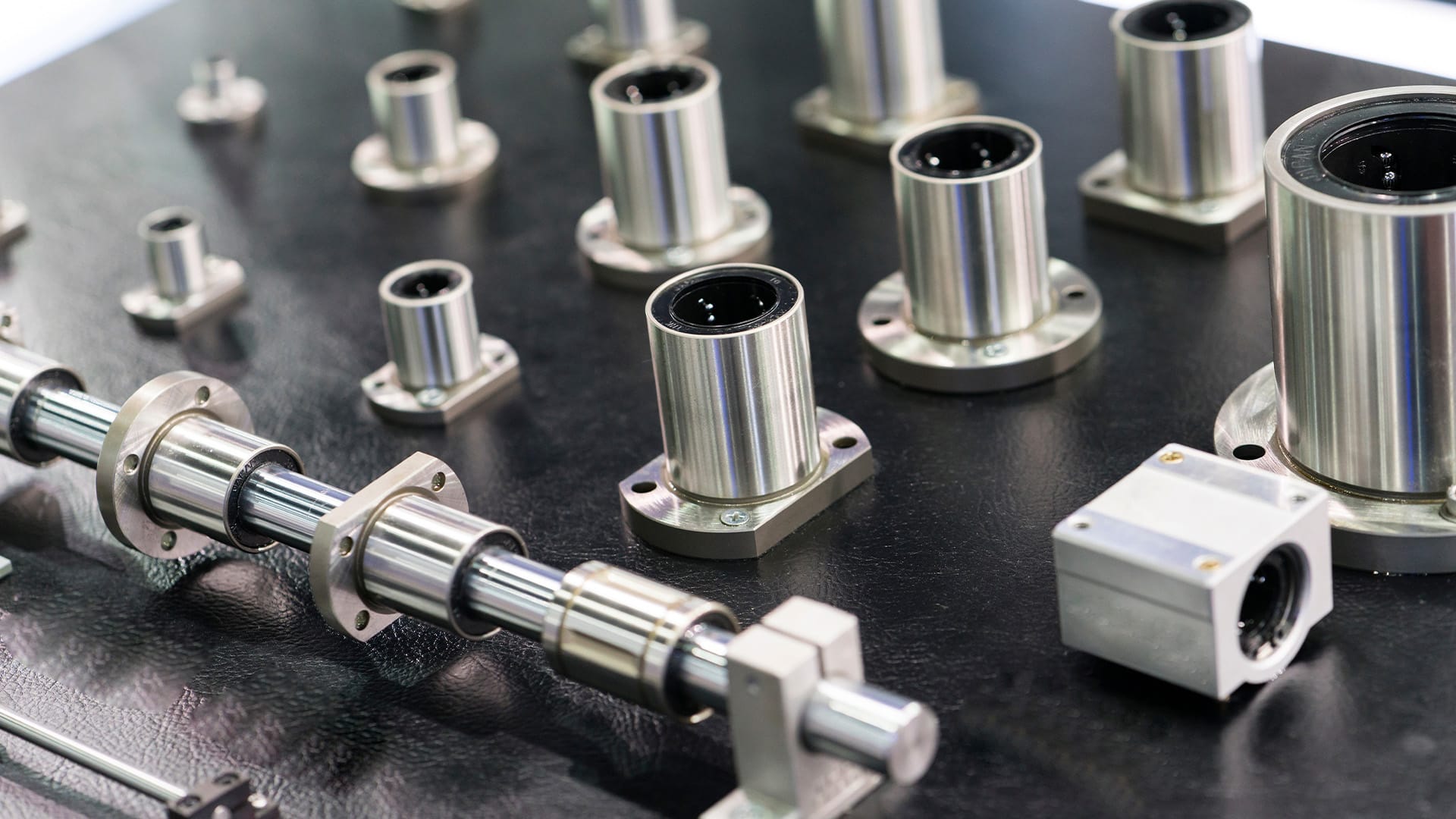
Profile rails (ball/roller carriages on profiled rails) deliver higher stiffness, accuracy, and load per length, but demand tight mounting straightness/parallelism and better sealing. Linear ball bushings ride on round shafts—more tolerant, modular, and economical, but lower stiffness/accuracy for the same footprint.
Industry Insights
Industry Insights
Linear Bearings
Types, Selection, Failures, Fixes & Coatings
What Are Linear Bearings?
Linear bearings guide and support motion along a straight path with minimal friction. Families include profile rail guides (recirculating ball/roller carriages on profiled rails), linear ball bushings (on round shafts), plain/polymer bushings, crossed-roller linear guides (non-recirculating), V-wheel/track systems, and air bearings. Choice depends on load, stiffness, accuracy, contamination, chemistry, and maintenance philosophy.
Typical uses: packaging & washdown machinery, CNC & automation axes, pick-and-place, medical & lab equipment, conveyors, inspection/Metrology stages, and harsh dusty environments with protected rail/shaft systems.
Linear Bearing Types — Quick Comparison
Start with environment & required stiffness. Add preload only as needed; protect against contamination first.
Profile Rail — Recirculating Ball
Preload optionsHigh speed
- Good accuracy/stiffness, broad availability, high travel speed.
- Add wipers/scrapers & bellows for washdown/dust; stainless or coated rails when needed.
- Requires straight/flat mounting; parallel rails need careful alignment.
- Explore Further
Profile Rail — Recirculating Roller
Highest stiffnessHeavy load
- Higher rigidity & load per carriage than ball type; great for cutting forces.
- More sensitive to contamination; prioritize scrapers and sealing.
- Explore Further
Linear Ball Bushing (Round Shaft)
EconomicalModular
- Open/closed styles; supported rails for stiffness on long spans.
- Shaft finish & hardness dominate life; coatings can improve corrosion/fretting resistance.
- Explore Further
Plain / Polymer Linear Bushings
Dry-runningContamination-tolerant
- Good in grit/chemistry; low noise; lower stiffness/accuracy vs. profile rails.
- Shafts must be corrosion-resistant and smooth; thermal growth matters.
Crossed-Roller Linear Guides (Non-Recirc.)
High precisionHigh stiffness
- No recirculation → ultra-smooth motion; shorter stroke limits.
- Sensitive to contamination; add covers/bellows; align very carefully.
- Explore Further
V-Wheel / Track Systems
RuggedField-serviceable
- Handles contamination better; easy to tension/replace wheels.
- Lower precision than profile rails; check track straightness and joint transitions.
Air Bearings (Linear)
FrictionlessCleanroom
- Near-zero friction & no wear debris; needs clean, dry air supply.
- Requires very flat/stable guide surfaces; sensitive to particulates.
Environment → Attributes Matrix
| Environment/Duty | Material / Coating | Preload / Clearance | Fit & Mounting | Sealing / Debris | Lubricant |
|---|---|---|---|---|---|
| Washdown / Food | Stainless or coated rails/shafts; corrosion-resistant housings | Light preload or none (avoid water drag); verify after seal contact | Use floating rail/shaft on one side for thermal growth | Full wipers + end seals; add bellows/deflectors; avoid direct jets at seals | NSF H1 grease; compatible with cleaners & temps |
| Abrasive / Dusty | Hard, low-roughness contact surfaces; protective coatings on shafts | Avoid heavy preload; debris increases friction/wear | Rigid backing for rails; supported shafts; guard from chips | Scraper seals; positive covers; vacuum/extraction if possible | Tackier greases where allowed; scheduled relube to purge fines |
| Cleanroom / Low-particle | Stainless, low-outgas lubes; air bearings for ultra-clean | Light preload for smoothness; minimize grease migration | High flatness/straightness; filtered air for air bearings | Low-drag seals; covers to limit film shedding | Low-vapor, cleanroom-rated oils/greases (or air) |
| High-Load / Cutting Forces | Profile rails (roller) or crossed-roller guides | Defined preload for stiffness; verify torque & life | Tight parallelism & bolt pattern; relief at joints | Sealed carriages; scraper caps; coolant guards | OEM grease or metered oil; monitor purge & contamination |
| Long Travel / Thermal Drift | Corrosion-resistant rails/shafts; stress-relieved bases | Minimal preload; compensate via structure, not friction | Fixed + floating rail strategy; expansion joints; straightness mapping | Continuous covers; cable/bellow guidance | Low-bleed lubes; check viscosity across temp range |
Common Failures & Diagnostics
Rapid Triage
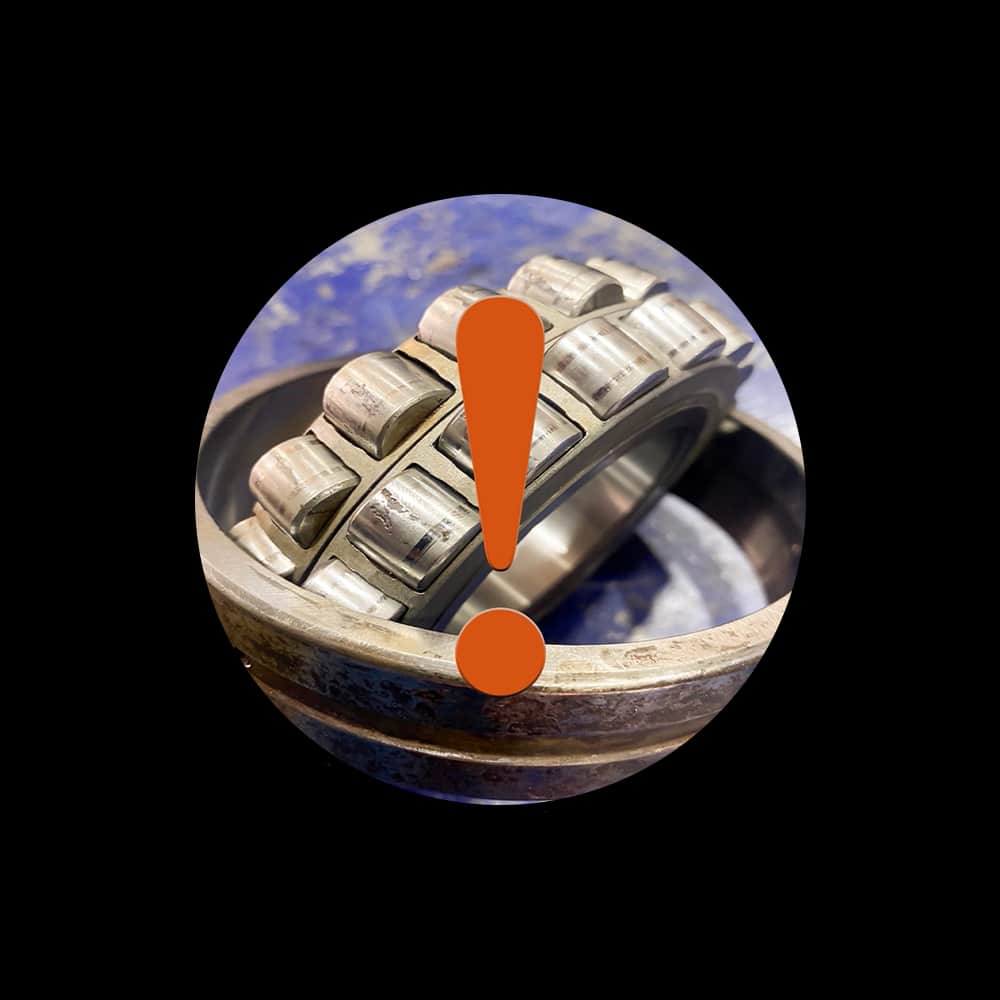
1) Contamination / Brinelling (Recirculating Types)
Symptoms
Clicking/roughness at repeat positions, visible indent lines on rails/shafts, rising drag.
Likely causes
Insufficient sealing/wipers; abrasive ingress; washdown without purge; magnetized debris.
Checks
Seal condition, wiper contact, bellows coverage, grease condition, debris mapping.
Non-coating actions
Upgrade scrapers, add covers, adjust purge/relube, demagnetize rails/shafts.
When surface treatments help
Hard, low-roughness chromium-family coatings resist fretting and corrosion initiation on rails/shafts.
2) Binding / Misalignment
Symptoms
Axis stalls or sings at certain travel; uneven preload; hot carriages.
Likely causes
Rail straightness, parallelism error, uneven base; thermal growth without float.
Checks
Straightedge/laser mapping; torque vs. position; shim map; temperature gradients.
Non-coating actions
Re-map & shim; adopt fixed+floating rail strategy; reduce preload; improve base.
When surface treatments help
Not primary—alignment dominates. Coatings only to protect surfaces during rework.
3) Corrosion / Washdown Damage
Symptoms
Brown staining at ends/seal lips, seized carriages after downtime, noisy restart.
Likely causes
Aggressive cleaners, direct jets at seals, poor drying, incompatible grease.
Checks
Cleaner pH/chemistry, spray angles, drain paths, grease compatibility tests.
Non-coating actions
Add deflectors/bellows; change wash protocol; switch to H1 grease validated vs. cleaners.
When surface treatments help
Thin dense/micro-cracked chrome on rails/shafts slows rust/crevice attack between cycles.
4) Stick-Slip / Poor Smoothness
Symptoms
Jerky motion at low speed, positional overshoot, squeal.
Likely causes
Over-preload, viscous drag from heavy grease, seal over-compression, misalignment.
Checks
Breakaway vs. running force; seal lip compression; preload class; carriage torque.
Non-coating actions
Reduce preload; pick lower-drag grease or light oil; relax seals where safe.
When surface treatments help
Low-roughness coatings can improve film formation and reduce micro-stick at slow speed.
The Big Three: Corrosion, Lubricity, Dimensional Stability
Use coatings when they address surface-driven mechanisms (corrosion, fretting/abrasion). Do not use coatings as a substitute for straightness, preload discipline, sealing, or alignment.
| Concern | What it means | Non-coating controls (first) | When coatings help | Notes |
|---|---|---|---|---|
| Corrosion resistance | Rails/shafts & carriage ways resist rust/chemical attack | Sealing, wipers/scrapers, bellows, jet angles, drying | Thin dense/micro-cracked chrome or similar on rails/shafts | Validate compatibility with cleaners/greases |
| Lubricity | Low friction, film persistence under vibration & slow strokes | Correct preload; proper grease/oil; purge after washdown | Micro-textured hard chrome can reduce fretting/false brinelling | Coatings complement lubrication, not replace it |
| Dimensional stability | Hold tolerance/straightness & preload after any processing | Flatness/parallelism control; thermal strategy; correct mounting | Controlled-thickness coatings; re-measure & map after coat | Thin sections & long rails are sensitivity hotspots |
Design Rules (Quick)
-
Start with environment: sealing & debris control first, then choose preload & accuracy.
-
Mounting drives life: control straightness/flatness/parallelism; use fixed + floating rails/shafts to absorb growth.
-
Preload sparingly: enough for stiffness, not so much to spike friction or trap debris.
-
After coating rails/shafts: re-measure straightness, size, and Ra; re-check preload/fit and seal contact.
Frequently Asked Questions
Use roller carriages for heavy loads, cutting forces, or when you need maximum structural stiffness. They’re more sensitive to contamination and alignment, so plan scrapers/covers and careful base prep.
Preload improves rigidity and precision but raises friction and debris sensitivity. Start with light preload for general automation. Increase only if deflection or chatter persists, and always verify breakaway/running torque and heat rise after installation.
Grease is simpler and can purge contamination; great for most axes and washdown (H1 where required). Oil suits high speed/cleanliness (metered systems). Match base oil viscosity to temperature and duty; avoid over-pressurizing seals.
Coatings change surface thickness/roughness, which can shift fit and preload. Use controlled-thickness coatings on rails/shafts, then re-measure size, straightness, and preload/torque. Check seal lip compression and wiper contact after coating.
Stainless offers bulk corrosion resistance but can trade hardness/wear. Coated alloy steel can combine hardness with a corrosion-resistant surface. In harsh cleaners, validate chemistry, jet angles, and drying either way; many teams use stainless carriages with coated rails/shafts.
Map straightness/flatness and rail parallelism; confirm fixed + floating strategy for thermal growth; verify joint transitions; measure torque vs. position and seal drag. Reduce preload if alignment is marginal.
Prioritize exclusion: scraper seals, end wipers, and full covers/bellows. Add filtration and scheduled purges. Consider polymer/plain linear bushings or V-wheel/track when grit is unavoidable.
Often yes—on rails/shafts. But you must re-qualify fit/preload and seal contact. Carriages with defined preload classes may need a different class after coating to hit target torque and life.
Use a fixed rail/shaft on one side and a floating counterpart on the other. Include expansion joints, manage cable forces, and minimize preload. For metrology axes, map straightness after thermal soak.
Contact Armoloy
Have a failure photo, sound clip, or spec? Upload it and we’ll assess the issue and outline recommended next steps.
Request Information