
Not by design. Provide a separate radial bearing, or use arrangements (e.g., tapered sets) engineered to share loads appropriately.
what you need to know
what you need to know
Thrust Roller Bearings
Selection, Failures, Fixes & Coatings
What Is a Thrust Roller Bearing?
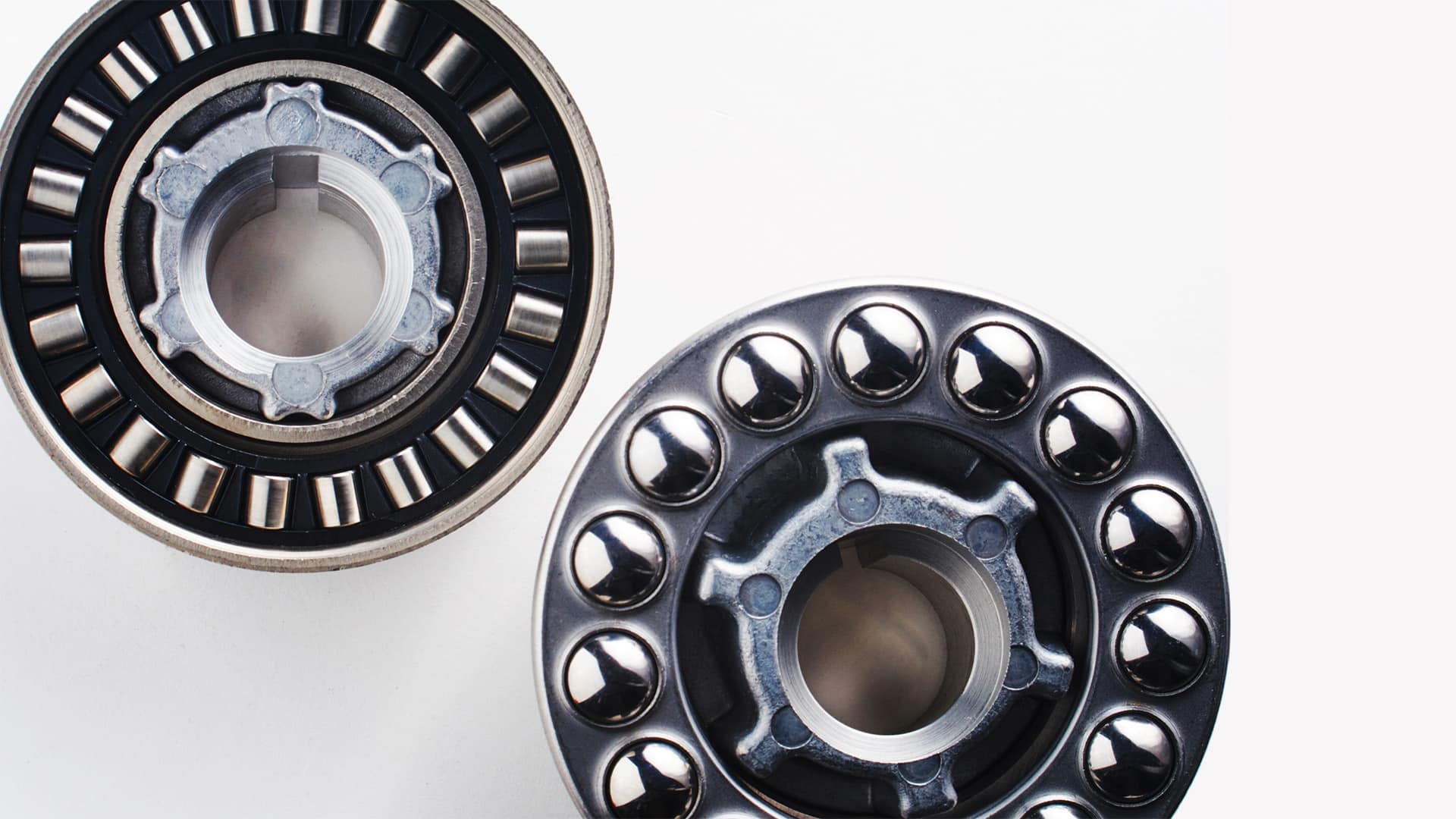
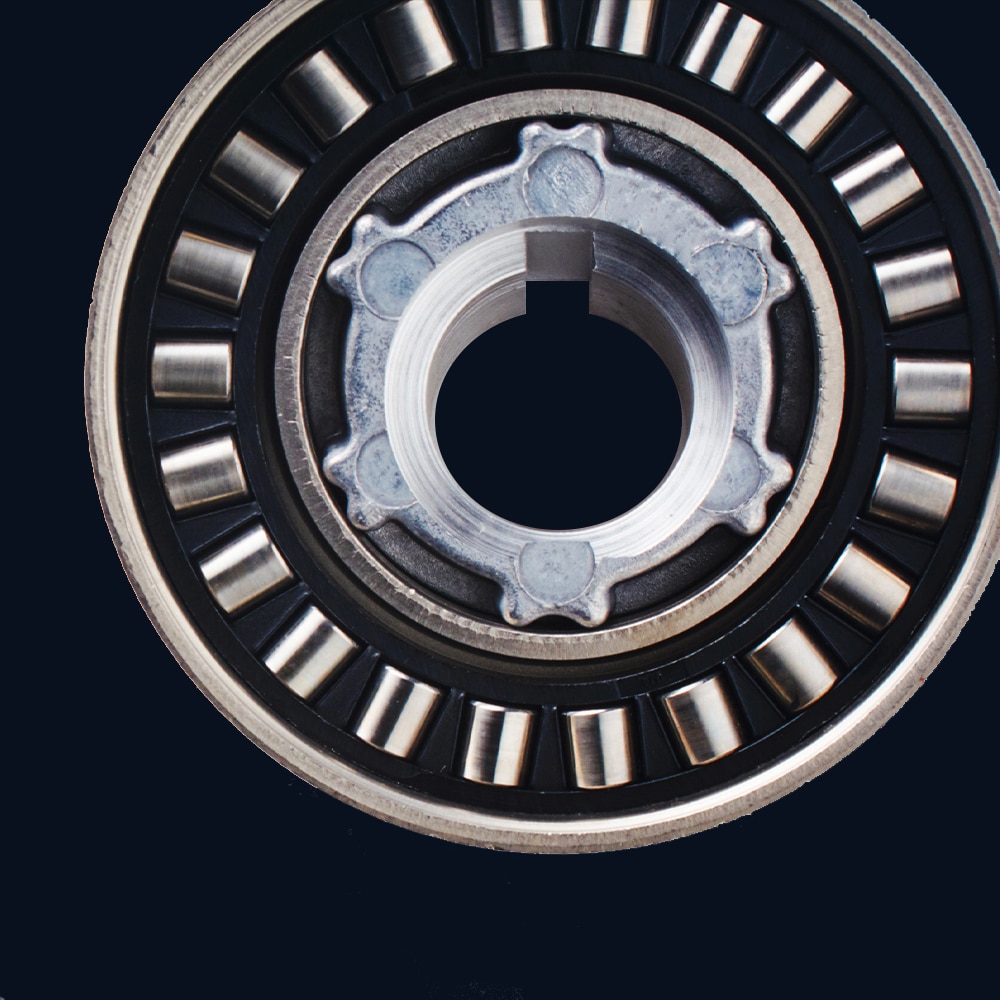
A bearing family that carries axial (thrust) load using line-contact rollers. Main types: cylindrical thrust (flat washers, very high axial capacity), tapered thrust (handles axial + some radial from geometry; very high capacity), spherical roller thrust (axial with misalignment tolerance), and needle thrust (compact axial). Radial capacity is minimal (except spherical thrust, which tolerates small radial components).
Typical uses: vertical pumps, screw drives, gearboxes, marine thrust blocks, extruders, machine tool spindles (axial), turntables, actuators, wind/industrial drives.
Selection Cheatsheet (Load, Direction, Alignment, Environment)
- Axial magnitude & direction: single-direction vs. double-direction; pick capacity with margin at operating temperature/viscosity.
- Alignment: if misalignment/shaft bending is likely, choose spherical roller thrust; otherwise cylindrical/tapered thrust for maximum stiffness/capacity.
- Radial loads present? Handle with a separate radial bearing (or tapered pairs) so the thrust unit sees primarily axial.
- Speed & heat: oil circulation or jet lubrication above moderate speed or high thrust; manage rib/roller end contacts.
- Environment: plan sealing/deflection and chemistry-compatible lubricants; control surface processes so thickness doesn’t shift geometry.
Environment → Attributes Matrix
| Environment | Preferred Type | Material / Coating | Fits / Seating | Sealing | Lubricant |
|---|---|---|---|---|---|
| Vertical pumps / drives | Cylindrical or tapered thrust (double direction if needed) | Through-hardened rings/rollers; chrome-family for corrosion | Square, flat seats; axial preload set per catalog | Labyrinths; oil seals on housings | Circulating oil sized for temp; rib cooling attention |
| Shock/misalignment (heavy industry) | Spherical roller thrust | Tough cages; optional wear/corrosion-resistant surfaces | Robust shoulders; verify misalignment within limits | Deflectors + debris guards | Grease or oil; watch temperature rise |
| Machine tools / precision axial | Cylindrical or tapered thrust (precision grades) | Low-roughness raceways; controlled thickness coatings only | Ground, flat seats; preload control; minimal runout | Non-contact shields; keep drag low | Light oil/oil-air; temperature-stable viscosity |
| Washdown / Caustic | Cylindrical thrust or spherical thrust (sealed housing) | Chromium-family or Ni-P; validate chemistry vs. cleaners | Protect seating faces; re-measure after coating | Contact seals + external deflectors | NSF H1 grease or compatible oil with drainage |
| Compact actuators / small mechanisms | Needle thrust | Controlled surfaces; avoid thickness that pinches washers | Flat, rigid seats; avoid embossing thin washers | External sealing at housing level | Grease with film persistence; avoid over-pack |
Common Failures & Diagnostics
Rapid Triage

1) Seat Distortion / Lack of Flatness
Symptoms
High local temperature, uneven contact, early spalling on one sector.
Likely causes
Soft or distorted housing/shaft seats; poor surface flatness/parallelism; over-torque on covers.
Checks
Blue check seat flatness; measure axial runout; verify clamping hardware torque and sequence.
Non-coating actions
Re-machine or lap seats; improve stiffness; correct clamp method.
When surface treatments help
Not a primary fix—geometry and stiffness first.
2) Starved Lubrication (roller ends / ribs)
Symptoms
Rising temperature with axial load, smear marks on rib faces or roller ends.
Likely causes
Viscosity too low at operating temperature; inadequate oil flow or grease channeling.
Checks
Oil temperature/viscosity; flow rate; path to rib/roller contacts; cage condition.
Non-coating actions
Increase viscosity or move to circulating oil/jet feed; reduce seal drag; add cooling if needed.
When surface treatments help
Low-roughness chrome can reduce scuffing once film & flow are adequate.
3) Misalignment / Edge Loading
Symptoms
Edge spalling, noisy operation under axial load, non-uniform wear.
Likely causes
Shaft/housing misalignment; thermal growth mismatch; assembly stack errors.
Checks
Measure misalignment; inspect stack tolerances; verify thermal model.
Non-coating actions
Use spherical roller thrust if misalignment unavoidable; improve alignment and stiffness.
When surface treatments help
Secondary only—won’t fix fundamental alignment issues.
4) Fretting / False Brinelling at Seats
Symptoms
Reddish debris at washer seats, micro-pits, noisy start-ups.
Likely causes
Micro-motion under vibration; insufficient clamp or poor surface finish.
Checks
Vibration exposure; clamp preload; seat finish; transport handling.
Non-coating actions
Increase clamp accuracy; improve finishes; isolate vibration during transport.
When surface treatments help
Micro-textured chrome on seats reduces adhesion once clamping is correct.
5) Contamination / Abrasive Wear
Symptoms
Gritty feel, debris in oil/grease, accelerated roller/race wear.
Likely causes
Poor seals/deflectors; filters overloaded or missing; wash jets at seals.
Checks
Ingress paths; filter/oil analysis; seal lip condition.
Non-coating actions
Upgrade sealing & filtration; adjust wash practices; purge plans.
When surface treatments help
Hard chrome extends life after ingress is controlled.
The Big Three: Corrosion, Lubricity, Dimensional Stability
Apply coatings where they solve surface-driven issues (corrosion, fretting, abrasion). Coatings do not replace correct seating, preload, or alignment.
| Concern | What it means | Non-coating controls (first) | When coatings help | Notes |
|---|---|---|---|---|
| Corrosion resistance | Protect raceways & seating faces from rust/chemicals | Sealing/deflection; jet management; compatible grease/oil; dry-out | Thin dense chrome, micro-cracked chrome, Ni-P (validated) | Confirm food/biocompatibility where required; re-measure geometry |
| Lubricity | Stable film at roller ends/ribs and raceways under high axial stress | Oil flow/viscosity at temperature; rib cooling; avoid starvation | Low-roughness or micro-textured chrome encourages film retention | Coatings complement—not replace—lubrication strategy |
| Dimensional stability | Maintain flatness/parallelism and preload after processing | Control seat flatness; set preload per catalog; verify run-in temperature | Controlled-thickness coatings; verify washer height/runout post-coat | Thin washers are sensitive—measure before/after processing |
Fits, Seating & Preload (Quick Rules)
-
Flatness/parallelism is king: thrust washers must seat on flat, rigid surfaces; verify with blue checks.
-
Set preload or endplay per catalog; monitor run-in temperature; adjust to avoid scuffing.
-
Separate radial support unless using arrangements designed to carry both (e.g., tapered sets).
-
After coatings: re-measure washer height/flatness; confirm preload didn’t shift from thickness change.
Checklist
-
Seat flatness/parallelism verified
-
Preload/endplay measured hot & cold
-
Lubrication flow to rib/roller ends confirmed
-
Post-coat geometry/runout inspected
Frequently Asked Questions
When misalignment/shaft deflection is unavoidable or shock loads are present. It sacrifices some stiffness vs. cylindrical/tapered thrust.
They can. Measure washer height/flatness/runout before and after processing; verify preload/endplay hot.
Use double-direction when axial forces reverse; center the rotating component between two thrust stages with a common middle washer.
Case Snapshots
- Vertical pump thrust block — Hot running and smear at rib faces.
Actions: switched to circulating oil with higher viscosity @ temp; added deflectors; verified seat flatness.
Outcome: temperature drop ~15–20 °C; smear eliminated; longer service interval. - Extruder gearbox — Fretting at thrust washer seat after washdowns.
Actions: improved clamp sequence/torque; micro-textured chrome on seat; H1 grease compatible with cleaners.
Outcome: fretting debris eliminated; quieter start-ups.
Contact Armoloy
Have a failure photo, sound clip, or spec? Upload it and we’ll assess the issue and outline recommended next steps.
Request Information