
Not recommended. Use an inner ring or upgrade the shaft to a hardened, ground raceway spec.
what you need to know
what you need to know
Needle Roller Bearings
Selection, Failures, Fixes & Coatings
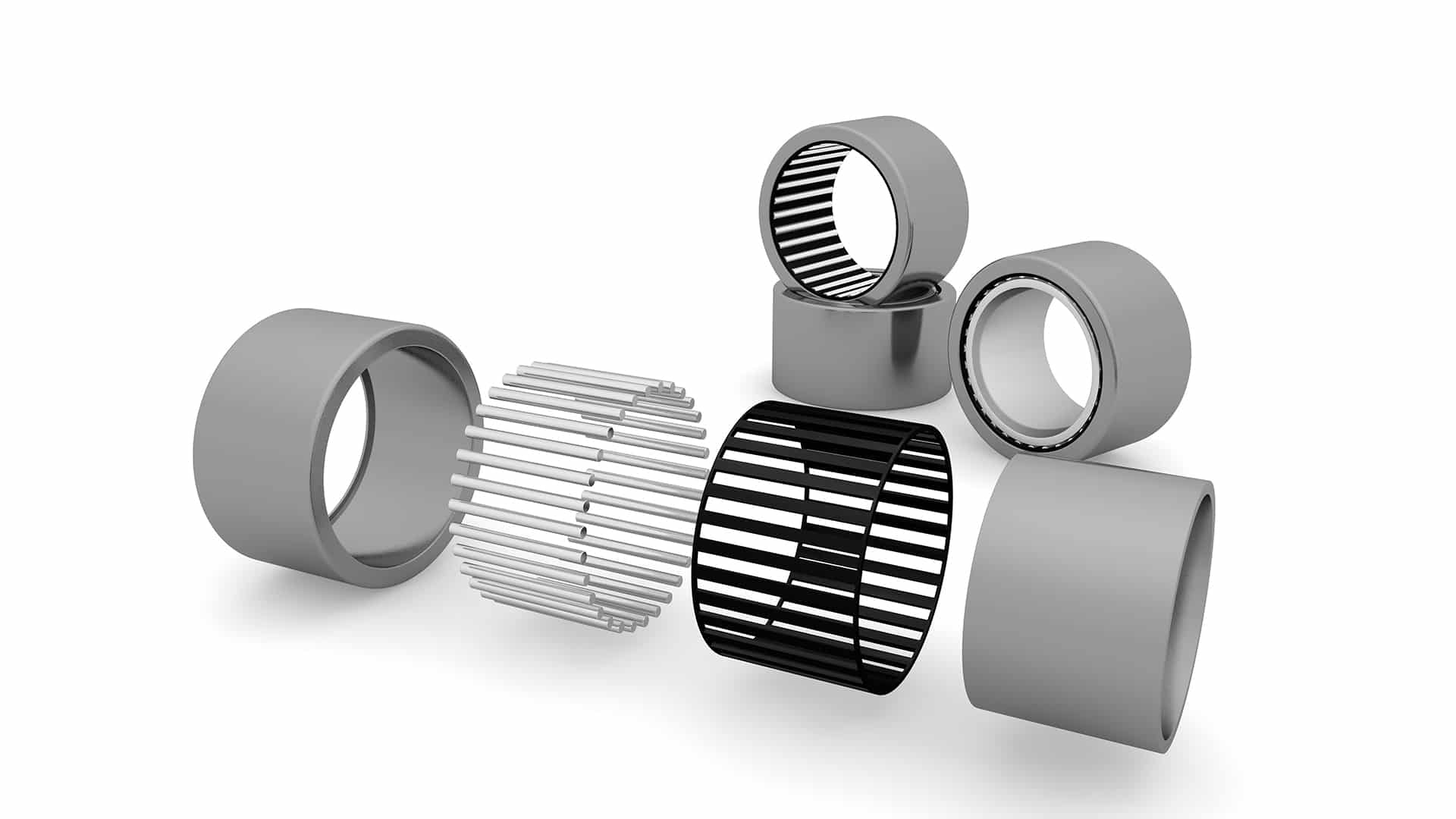
What Is a Needle Roller Bearing?
A compact radial bearing using many small-diameter rollers to achieve very high radial capacity per envelope. Offered as drawn-cup (thin-wall) and machined-ring (heavy-duty) types, with or without an inner ring (the shaft may serve as the inner raceway). Available in caged (higher speed) and full-complement (max capacity) designs.
Typical uses: compact gearboxes, transmissions, pumps, small motors/tools, agricultural & construction equipment, appliance drives, and mechanisms with tight packaging.
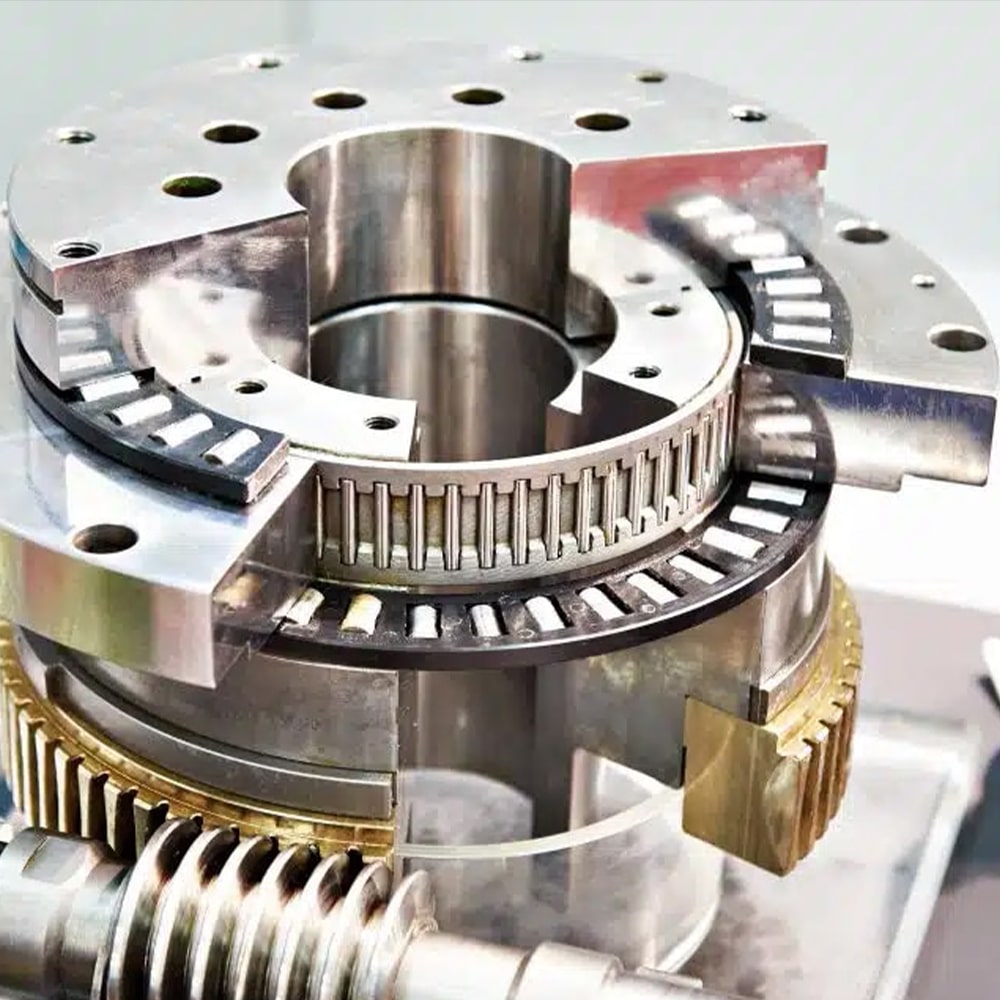
Selection Cheatsheet (Raceway, Envelope, Environment)
- Inner ring vs. shaft raceway: choose an inner ring if the shaft can’t meet hardness/finish or service wear is expected.
- Drawn-cup vs. machined-ring: drawn-cup for tight envelopes/press-fit housings; machined-ring for higher stiffness & shock.
- Caged vs. full-complement: caged for speed/film formation; full-complement for max radial load at modest speed/oscillation.
- Axial loads? Pair with a thrust needle or use a separate axial bearing; radial NRB alone is not an axial solution.
- Environment: plan sealing/deflection and grease that survives wash, dust, or cleaners; validate chemistry.
- Surface treatments: apply to curb corrosion/fretting/abrasion; control thickness so ID/OD/roundness and clearance remain in spec.
Environment → Attributes Matrix
| Environment | Material / Coating | Type & Configuration | Fits / Mounting | Sealing | Lubricant |
|---|---|---|---|---|---|
| Washdown / Food | Chromium-family or Ni-P on rings/shafts; stainless options where offered | Caged drawn-cup with inner ring if shaft spec is marginal | Press-fit per catalog; verify ID after press & after coating | Contact seals + deflectors; avoid direct jets at lips | NSF H1 grease validated vs. cleaners & temperature |
| Abrasive / Dusty | Hard, low-roughness surfaces; coated shafts/rings for wear | Machined-ring or heavy-duty; full-complement if speed is modest | Robust housing; interference on rotating ring | Deflectors + labyrinths; purge paths | Grease with sealing behavior; scheduled purges |
| High-Speed / Continuous | Low-roughness raceways; controlled geometry | Caged type; inner ring for shaft protection | Precision shoulders; alignment control | Low-drag shields or non-contact sealing | Low-bleed grease or light oil feed; verify heat |
| Oscillation / Idle Vibration | Micro-textured hard chrome for fretting resistance | Caged preferred; full-complement only if speed is very low | Tight runout/roundness; avoid micro-motion at seats | Contact seals; isolate vibration during transport | Grease with film persistence; controlled relube |
| Compact / Thin Housing | Coatings with tight thickness control to protect ID | Drawn-cup; consider inner ring to protect shaft | Measure ID after press; support during pressing | External seals in housing; deflectors | Grease with good channeling; avoid overpack |
Common Failures & Diagnostics
Rapid Triage
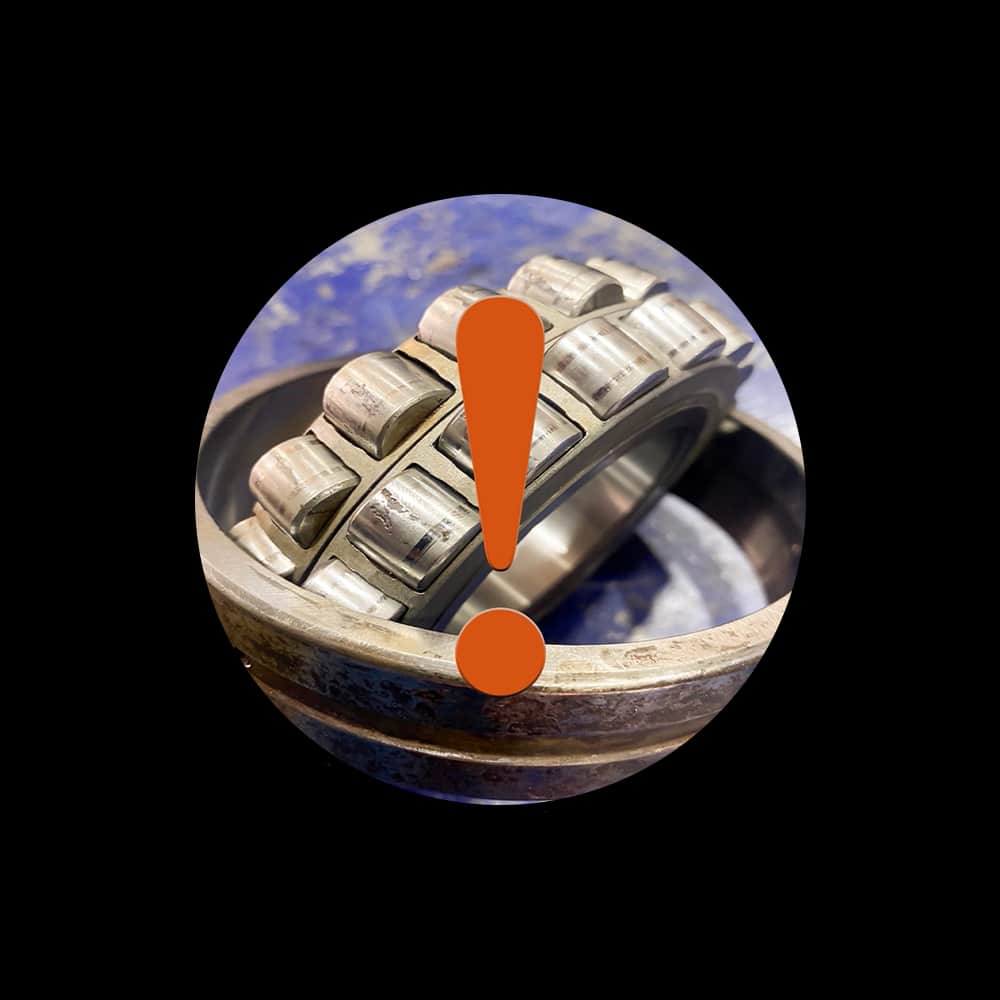
1) Shaft Raceway Wear / Galling
Symptoms
Polished bands/transfer on the shaft, noise, rising torque.
Likely causes
Shaft too soft/rough; inadequate film; contamination; oscillation with low bleed grease.
Checks
Shaft hardness/finish vs. spec; lubricant grade at temperature; debris analysis.
Non-coating actions
Specify inner ring or upgrade shaft raceway spec; improve lubrication & sealing.
When surface treatments help
Hard, low-roughness chrome on shaft/inner ring once base spec is correct.
Won’t solve
Running on an unhardened shaft.
2) False Brinelling / Fretting (idle vibration)
Symptoms
Pitch-spaced dull dents, reddish/brown oxide, start-up roughness.
Likely causes
Micro-motion at rest; poor film persistence; transport vibration.
Checks
Idle vibration exposure; grease bleed/consistency; clamping/mounting micro-slip.
Non-coating actions
Stabilize transport; select grease with stronger film; adjust preload/seat to reduce micro-motion.
When surface treatments help
Micro-textured chrome resists adhesion and debris once motion/film are controlled.
Won’t solve
Large amplitude vibration or chronic under-lubrication.
3) Drawn-Cup Creep / Rotation in Housing
Symptoms
Shiny bands or black dust at the cup OD; positional drift.
Likely causes
Insufficient press-fit; thin wall housing; thermal cycles; poor bore finish.
Checks
Housing bore size/finish/roundness; press-fit vs. catalog; temperature profile.
Non-coating actions
Increase interference; improve bore finish; consider retaining features or switch to machined-ring.
When surface treatments help
Not a primary fix—address fit and housing stiffness first.
Won’t solve
Loose bores or oval housings.
4) Cage Wear / Skewing
Symptoms
Noise at speed, metallic debris, heat rise.
Likely causes
Insufficient lubrication at speed; misalignment; overload; full-complement used beyond speed limit.
Checks
Viscosity at temperature; speed vs. type (caged/full-complement); alignment.
Non-coating actions
Move to caged design; improve lubrication delivery; correct alignment/load.
When surface treatments help
Secondary—coatings won’t prevent cage starvation.
5) Contamination / Abrasive Wear
Symptoms
Gritty feel, debris in grease/oil, accelerated wear.
Likely causes
Ingress via inadequate sealing/deflection; filtration gaps; direct wash jets.
Checks
Ingress routes; seal lip condition; filter analysis; upstream guards.
Non-coating actions
Upgrade sealing/labyrinths; improve filtration; purge/change intervals.
When surface treatments help
Hard, low-roughness surfaces extend life once contamination is controlled.
Corrosion, Lubricity, Dimensional Stability
Use coatings where they address surface-driven issues (corrosion, fretting, abrasion). Coatings don’t replace correct fits, raceway specification, or sealing.
| Concern | What it means | Non-coating controls (first) | When coatings help | Notes |
|---|---|---|---|---|
| Corrosion resistance | Prevent rust in tight ID/OD geometries and at raceways/seats | Seals/deflectors; jet management; compatible grease; drying | Thin dense chrome, micro-cracked chrome, Ni-P (validated) | Control thickness—small changes can tighten IDs |
| Lubricity | Film retention under oscillation/idle vibration | Grease selection for film persistence; avoid under-/over-pack | Low-roughness or micro-textured chrome reduces fretting/false brinelling | Coatings complement, not replace, lubrication strategy |
| Dimensional stability | Hold ID/OD/roundness after press/coating so running clearance stays correct | Measure after press; confirm shaft/housing geometry & hardness | Controlled-thickness coatings; verify post-process dimensions | Drawn-cup shells are sensitive to press-fit & ovality |
Fits, Tolerances & Clearance (Quick Rules)
- Drawn-cup: press-fit per catalog; support during pressing; measure ID and roundness after press.
- Shaft as raceway: hardened & ground with controlled finish and geometry; verify after any surface process.
- Inner ring option: use when shaft spec/hardness is marginal or where service wear is expected.
- After coatings: re-measure ID/OD/runout; small thickness changes can shift clearance significantly.
Frequently Asked Questions
When the shaft can’t meet hardness/finish, when service wear is expected, or for easier replacement/repair.
Press-fit ovality or coating thickness changed the effective ID. Measure after press and after any surface treatment.
Caged for speed and lubrication margin; full-complement for maximum radial capacity at modest speed.
Radial NRBs do not. Use a thrust needle bearing or another axial solution for axial loads.
Case Snapshots
- Compact gearbox — Fretting marks after idle storage.
Actions: switched to grease with better film persistence; added transport restraints; micro-textured chrome on inner ring.
Outcome: start-up roughness eliminated; longer idle intervals tolerated. - Washdown conveyor idler — Cup creep and early wear.
Actions: increased press-fit per catalog; added deflectors; selected H1 grease compatible with cleaners.
Outcome: creep dust disappeared; interval to first service doubled.
Contact Armoloy
Have a failure photo, sound clip, or spec? Upload it and we’ll assess the issue and outline recommended next steps.
Request Information