
Choose X when you need axial load in both directions in a single row. Use A when you want controlled preload and higher radial stiffness.
what you should know
what you should know
Thin Section (Constant Cross-Section) Ball Bearings
Selection, Failures, Fixes & Coatings
What Is a Thin-Section (Constant Cross-Section) Ball Bearing?
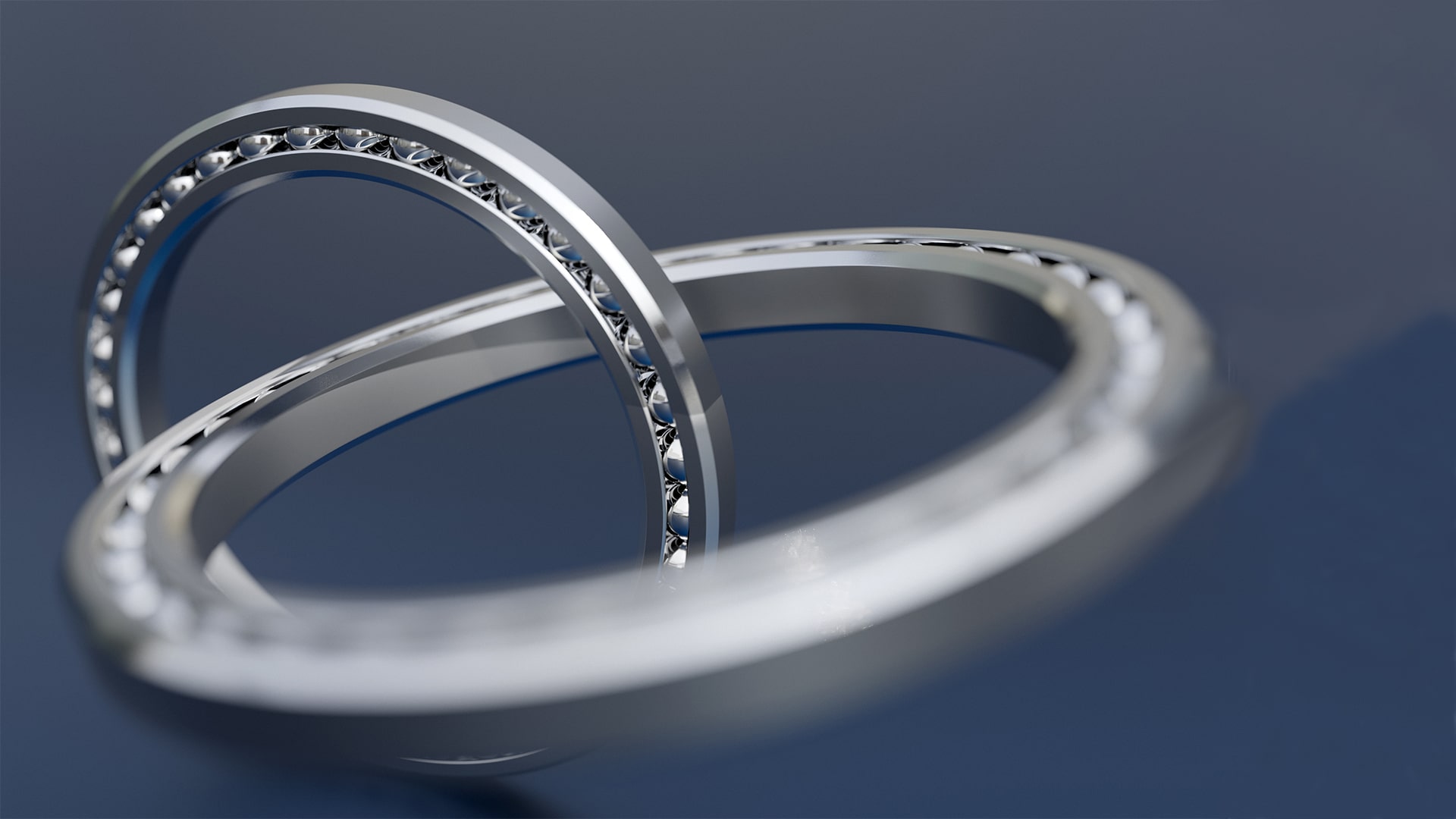
A ball bearing family where the radial cross-section stays constant as bore size changes—enabling large bore/OD with minimal mass and compact envelopes. Offered as radial (C-type), angular-contact (A-type), and four-point (X-type) within the same cross-section.
Typical uses: robotics & cobots, medical/diagnostic devices, aerospace mechanisms, gimbals & turntables, instrumentation, AGV/AMR hubs, packaging pick-and-place where space and weight are critical.

Selection Cheatsheet (Envelope, Load Path, Stiffness)
- Space/weight is the driver: use thin-section to hold a constant cross-section while increasing bore/OD.
- Pick the type by load path: C for radial-dominant; A for combined loads & stiffness (preloadable); X for axial both directions when a single row must do it.
- Stiffness vs. heat: higher preload improves positional accuracy but raises torque/temperature—tune for duty cycle.
- Mounting matters: minimize ring distortion—use piloting shoulders, even clamp loads, and torque control.
- Coating awareness: ultra-thin rings require tight thickness control; verify geometry, runout, and seal gaps post-process.
Environment → Attributes Matrix
| Environment | Material / Coating | Type & Preload | Fit / Mounting | Sealing | Lubricant |
|---|---|---|---|---|---|
| Cleanroom / Medical | Clean, passivated steel; controlled-thickness surfaces | A-type light preload for stiffness; keep heat in check | Slip/light interference; torque-controlled clamps; avoid ring bowing | Shields or open for low drag | Low-bleed precision grease; low volatility |
| Vacuum / Space | Low-outgassing surfaces; avoid trapped volatiles | A or X depending on thrust; preload minimal to limit heat | Precisely flat mounting faces; controlled clamp loads | Open or shields | Space-grade oils/greases (low vapor pressure) |
| Robotics / Automation | Hard, low-roughness surfaces; optional corrosion-resistant coatings | A-type for stiffness; X-type if axial both directions in one row | Pilot diameters preferred; balanced clamp rings | Shields or light seals per torque budget | Low-bleed grease; check torque vs. cycle |
| Light Wash / Humid | Chromium-family or Ni-P with tight thickness control | C or A; keep preload conservative if seals increase drag | Avoid heavy interference; verify seal gaps post-coat | Shields or low-drag seals + deflectors | Cleaner-compatible grease if exposure expected |
| High Speed / Low Torque | Through-hardened steel or hybrid (ceramic balls) per design | A-type light preload; X only if axial dictates | True running pilots; runout-friendly clamping hardware | Open/shields preferred | Low-bleed, high-speed grease or oil mist |
Common Failures & Diagnostics
Rapid Triage

1) Ring Distortion / Geometry Shift
Symptoms
Rising torque, uneven noise, unexpected runout; clearance/preload not as built.
Likely causes
Over-tight clamp, uneven bolt torque, non-flat seats, heavy interference, post-process thickness change.
Checks
Mounting flatness; bolt pattern torque; pre/post geometry; pilot shoulder contact; coating thickness maps.
Non-coating actions
Use piloted fits; lighten interference; apply even clamp rings; torque sequence; verify face flatness.
When surface treatments help
Only after mechanics are correct; choose tightly controlled thickness processes.
Won’t solve
Warped housings, poor flatness, or clamp over-load.
5) Abrasive Contamination (less common by design)
Symptoms
Gritty feel, debris in grease, torque creep.
Likely causes
Ingress from poor guarding/filters; seal choice too open for the environment.
Checks
Ingress routes; upstream filtration; seal wear pattern.
Non-coating actions
Improve shielding/labyrinths; consider light seals if torque allows; tighten cleanliness controls.
When surface treatments help
Hard, low-roughness surfaces can reduce cutting once ingress is controlled.
Won’t solve
Active contamination sources or open paths.
3) Fretting / False Brinelling (vibration at rest)
Symptoms
Pitch-spaced dents, reddish/black oxides, start-up roughness after idle.
Likely causes
Micro-motion under small oscillations; thin film persistence issues.
Checks
Idle vibration; transport; grease bleed/consistency; fits that allow micro-slip.
Non-coating actions
Stabilize transport/idle; select grease with better film persistence; refine fits.
When surface treatments help
Low-roughness or micro-textured hard chrome can reduce adhesive onset.
Won’t solve
Excessive vibration amplitude or gross looseness.
4) Corrosion (humid/cleaning exposure)
Symptoms
Staining near shields/seals; torque rise post-cleaning; roughness.
Likely causes
Ingress, inadequate drying, incompatible lubricants, aggressive cleaners.
Checks
Ingress points; drying protocol; media pH/chemistry; film condition.
Non-coating actions
Improve sealing/deflection; adjust cleaning; pick compatible grease; rinse/dry.
When surface treatments help
Thin dense chrome or Ni-P for corrosion margin—with measured thickness.
Won’t solve
Persistent exposure with open ingress or wrong grease.
2) Skidding / Smearing (under-preload at speed)
Symptoms
Polished bands, heat at run-up, erratic torque.
Likely causes
Preload too light; viscosity too low at temperature; wrong type (C vs A/X) for duty.
Checks
Preload class; temperature/grease film; dn factor; contact angle (A) vs. load.
Non-coating actions
Increase preload one step; choose higher film strength/viscosity; consider A-type or hybrid balls if appropriate.
When surface treatments help
Micro-textures can aid film retention once preload is correct.
Won’t solve
Fundamental preload/contact-angle mismatch.
The Big Three: Corrosion, Lubricity, Dimensional Stability
Apply coatings when they address a surface-driven issue (corrosion, fretting, abrasion). Do not treat coatings as a substitute for correct fits, preload, flatness, or careful clamping—thin rings are unforgiving.
| Concern | What it means | Non-coating controls (first) | When coatings help | Notes |
|---|---|---|---|---|
| Corrosion resistance | Prevent rust/chemical attack without compromising geometry | Judicious sealing/shields; manage exposure; dry after cleaning | Thin dense chrome (nodular), micro-cracked chrome, Ni-P—tightly controlled thickness | Verify food/biocompatibility where relevant; confirm post-coat runout |
| Lubricity | Low friction & stable film under small oscillations or start/stop | Correct preload (A/X); low-bleed grease; avoid over-sealing drag | Micro-textured hard chrome can resist fretting/false brinelling | Coatings complement film retention; they don’t fix wrong preload |
| Dimensional stability | Hold geometry, preload/clearance, and seal gaps in thin rings | Avoid heavy interference; flat, even clamps; torque control; thermal model | Controlled-thickness coatings; verify runout, bore/OD, and shoulder interfaces | Thin sections amplify tiny changes—measure before/after process |
Case Snapshots
- Robot joint (A-type) — Torque spikes after assembly.
Actions: re-cut clamp ring for flatness, cross-pattern torque, reduced preload; verified runout.
Outcome: 30% torque reduction; temperature stabilized. - Medical carousel (X-type) — Fretting marks after shipment.
Actions: transport isolation, low-bleed grease, micro-textured raceway finish.
Outcome: fretting eliminated; smoother start-up.
Frequently Asked Questions
Keep interference light. Thin rings distort—use pilots and clamp rings with torque control for location.
Not necessarily, but seals add drag and heat. Use the lightest sealing that meets the environment and re-check preload/torque.
They can if thickness isn’t tightly controlled. Always measure geometry and verify performance after processing.
Contact Armoloy
Have a failure photo, sound clip, or spec? Upload it and we’ll assess the issue and outline recommended next steps.
Request Information