
Only limited axial capability. For substantial thrust, consider angular-contact or tapered roller bearings.
what you should know
what you should know
Self-Aligning Ball Bearings
Selection, Loads, Failures, and Surface Treatment Options
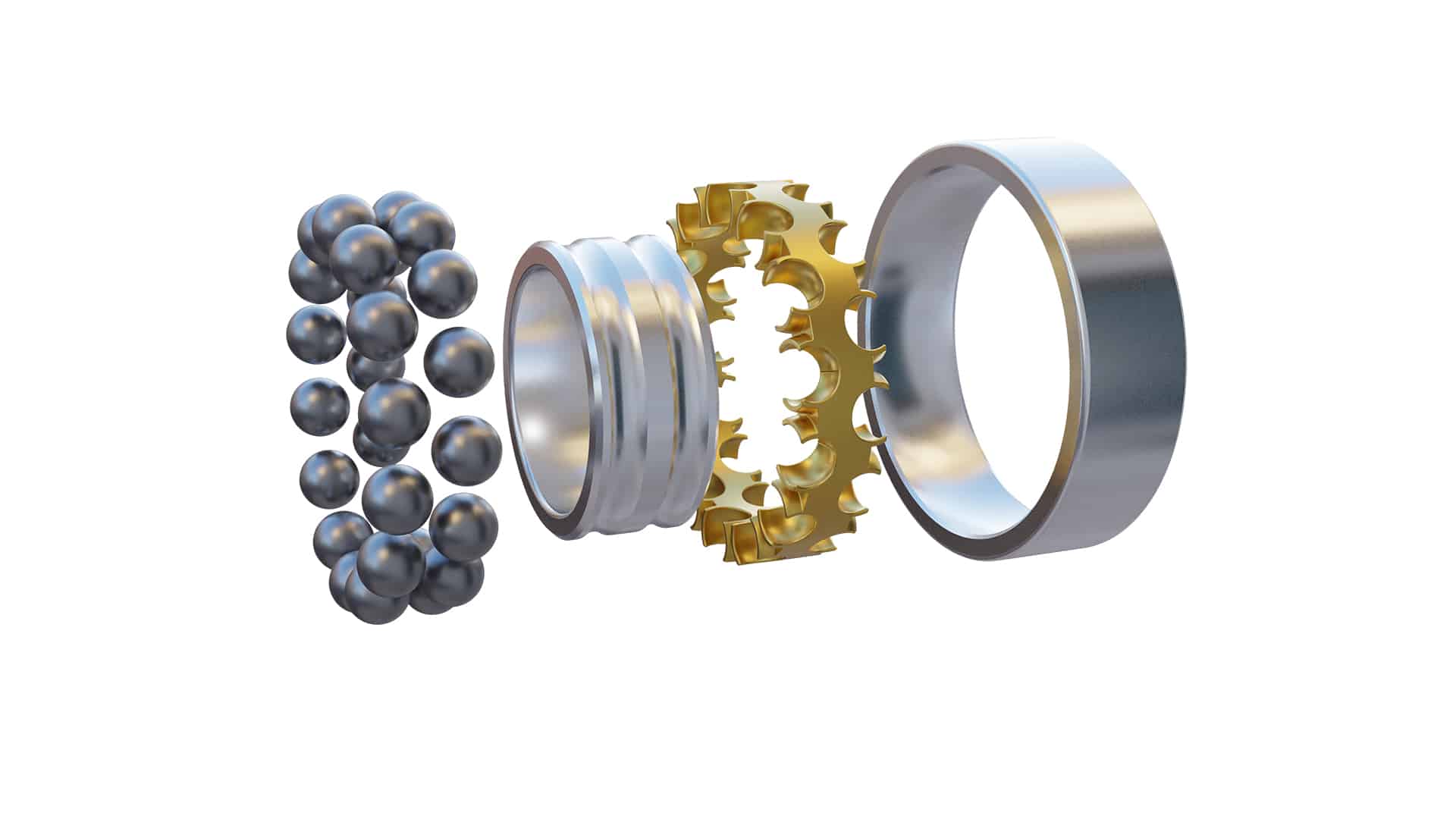
What Is a Self-Aligning Ball Bearing?
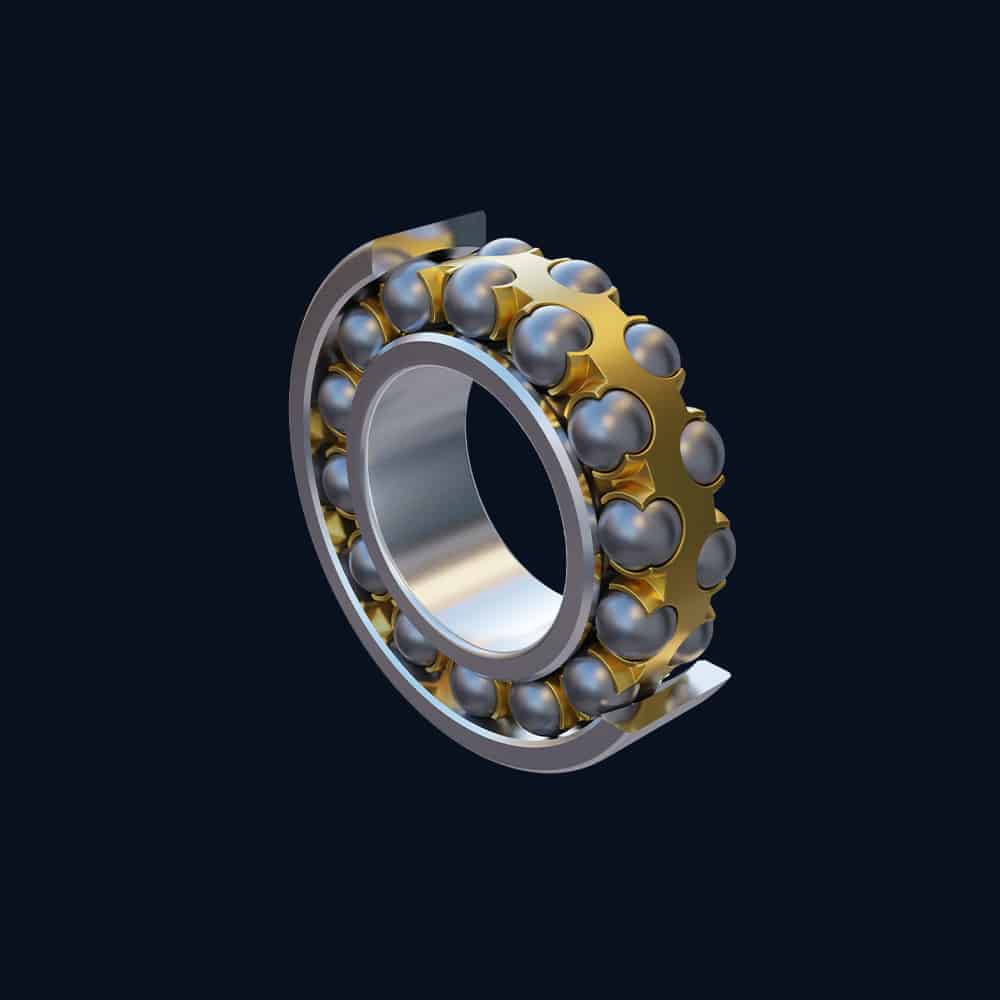
A double-row ball bearing with a spherical outer-ring raceway that allows the inner ring/shaft to run at an angle relative to the housing. Primarily supports radial loads with limited axial capacity in both directions, while tolerating shaft deflection or mounting misalignment.
Typical uses: long shafts with deflection, belt-driven equipment, fans/blowers, conveyors, agricultural machinery, and housed units where alignment is difficult.
Selection Cheatsheet (Load & Alignment)
- Misalignment unavoidable (mounting tolerance, shaft deflection): choose self-aligning ball bearings and verify the series’ rated misalignment angle.
- Radial load dominant; axial limited: SABB is appropriate. For substantial axial load, move to angular-contact or tapered roller.
- Long shafts / belt drives: favor housed units with spherical seats to preserve the self-aligning function.
- Space/weight constrained: choose a narrower series; confirm stiffness and seal options.
- Harsh washdown/caustic: contact seals + deflectors, cleaner-compatible H1 grease, and corrosion-resistant surfaces.
Environment → Attributes Matrix
| Environment | Material / Coating | Clearance | Fit (shaft / housing)* | Sealing | Lubricant |
|---|---|---|---|---|---|
| Washdown / Food | Stainless or coated rings; stainless/ceramic balls | C3 (to absorb interference & thermal) | k5–m6 / H7; ensure spherical seat can move | 2RS + deflectors; protect seal lips from jets | NSF H1 grease validated vs. cleaners/temps |
| Abrasive / Dusty | Coated rings; hard, low-roughness surfaces | C3 | k5–m6 / H7; add slingers/labyrinths | 2RS or shield + labyrinth | Grease with strong sealing behavior |
| Cleanroom / Vacuum | Clean, passivated steel; controlled surfaces | Per thermal model | Controlled interference to prevent creep | Non-contact shields or labyrinths | Low-outgassing oils/greases (minimal volatility) |
| High-Speed (moderate axial) | Through-hardened steel; consider hybrid balls | C0–C3 (match heat & speed) | Precision fits; verify dn and heat rise | Shields or low-drag seals | Low-bleed grease or oil per catalog |
| High-Temp Wash / Caustic | Coated rings (chromium or Ni-P); stainless balls | C3 | k5–m6 / H7; check post-wash drying | 2RS + external deflectors | H1 grease with cleaner & heat compatibility |
*Assumes rotating inner ring; adjust for your kinematics.
Common Failures & Diagnostics
Rapid Triage
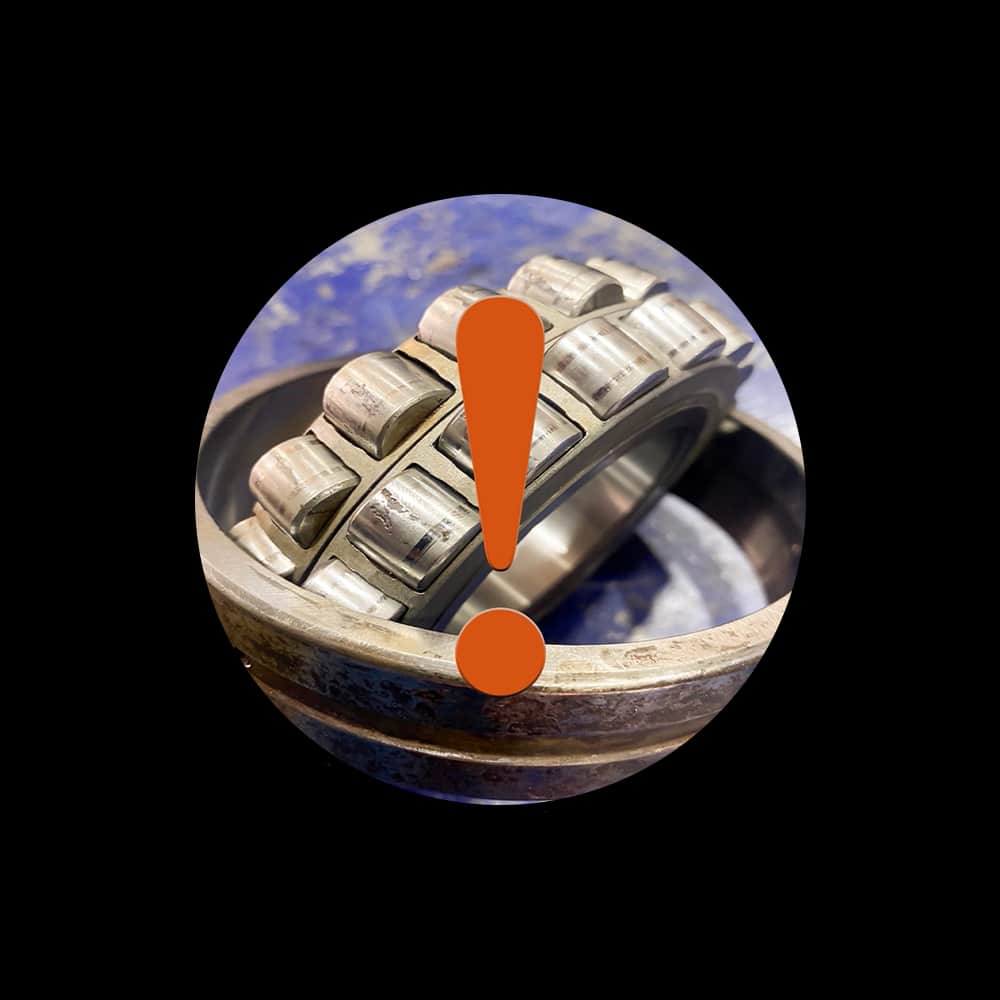
1) Corrosion (pitting/crevice/rust staining)
Symptoms
Brown/red staining near seals, rough running, elevated noise after washdown cycles.
Likely causes
Water/chemical ingress; inadequate post-wash drying; cleaner pH/chemistry attacking steel; marginal grease film.
Checks
Seal condition and contact; ingress paths (shaft shoulders, housings); cleaner MSDS/compatibility; water jets aimed at seals.
Non-coating actions
Improve sealing (contact + deflectors), adjust washdown angles/pressures, select compatible H1 grease, add purge routine, consider stainless rings/balls.
When surface treatments help
Hard, inert chromium-family or electroless nickel surfaces that resist corrosion initiation and crevice attack at raceways/shoulders.
Won’t solve
Chronic misalignment, loose fits that pump fluid in, underspecified seals.
2) Fretting / False Brinelling
Symptoms
Evenly spaced dents at ball pitch, reddish/black oxide, start-up roughness after idle or transport.
Likely causes
Vibration at rest; micro-slip from loose fits; inadequate lubricant film persistence.
Checks
Fits (shaft/housing), vibration levels during transport/standby, preload (if applicable), grease bleed/retention.
Non-coating actions
Tighten fits or add locking features; transportation locks or isolation; select grease with better film retention; minimize idle vibration.
When surface treatments help
Micro-textured hard chrome can reduce adhesive onset and oxide debris generation after root causes are controlled.
Won’t solve
Persistent large-angle oscillation, structural misalignment, or grossly loose fits.
3) Edge Stress / Spalling (misalignment beyond rating)
Symptoms
Elevated heat and noise; localized raceway edge damage; shortened life despite “self-aligning” design.
Likely causes
Misalignment angle exceeds catalog limit; spherical seat/housing constrains bearing’s self-alignment; bent shaft.
Checks
Measure installed misalignment vs. rated angle; inspect spherical seat freedom and housing geometry; check shaft straightness.
Non-coating actions
Restore self-aligning freedom (proper seat, clearance); reduce misalignment by correcting mounting or shaft deflection; consider a series with higher misalignment tolerance.
When surface treatments help
Not applicable as a primary fix—address geometry and alignment first.
Won’t solve
Any geometry/alignment error that pushes contact to raceway edges.
4) Abrasive Wear / Contamination
Symptoms
Gritty sound, rising torque, particulate in grease, accelerated seal wear.
Likely causes
Ingress of dust/slurry; ineffective sealing; lack of slingers or labyrinths; poor upstream filtration.
Checks
Ingress points (seal lips, shaft shoulders), seal wear patterns, presence of fines in grease, upstream shielding/filtration.
Non-coating actions
Upgrade sealing (2RS + slingers/deflectors), add labyrinths, improve filtration, implement purge relube intervals.
When surface treatments help
Hard, low-roughness surfaces can reduce cutting and extend life when paired with better sealing.
Won’t solve
Open ingress paths or chronic contamination sources.
5) Creep at Seats (ring micro-movement)
Symptoms
Polished or darkened (oxide) bands at seat interfaces; positional drift; black dust near joint.
Likely causes
Insufficient interference fit; thermal cycling; inadequate clamping of spherical seat components.
Checks
Verify shaft/housing tolerances; inspect witness marks; confirm seat clamping torque and component flatness.
Non-coating actions
Increase interference or add mechanical locks; correct tolerances; ensure spherical seat is properly retained yet free to align.
When surface treatments help
Generally not a substitute for proper fits; surface changes won’t prevent macro-movement.
Won’t solve
Loose fits, poor seat retention, or thermal growth mismatch.
The Big Three: Corrosion; Lubricity; Dimensional Stability
| Concern | What it means | Non-coating controls (first) | When coatings help | Notes |
|---|---|---|---|---|
| Corrosion resistance | Rust/crevice/chemical attack in target environment | Sealing strategy, jet angle, drying, cleaner-compatible grease | Thin dense chrome (nodular), microcracked chrome | Validate food/biocompatibility where applicable; check cleaner pH |
| Lubricity | Low friction & film retention under vibration/oscillation | Correct clearance; prevent seat binding; grease selection/relube | Micro-textured hard chrome can resist fretting/false brinelling | Coatings complement, not replace, proper fits and alignment |
| Dimensional stability | No detrimental change to geometry/clearances or seal gaps | Confirm fits & spherical seat freedom; thermal model | Controlled-thickness coatings; verify post-coat runout & seal gaps | Thin sections are sensitive—tight thickness control |
Case Snapshots
- Fan assembly with shaft deflection — Edge spalling after alignment attempts.
Actions: switched to SABB with true spherical seat, added deflectors, cleaner-compatible H1 grease.
Outcome: torque stabilized; inspection at 6 months showed no edge stress. - Conveyor idler (washdown) — Rust staining and roughness after 8 weeks.
Actions: 2RS seals + slingers, rinse/dry protocol, coated rings for corrosion resistance.
Outcome: service interval extended to 24+ weeks between checks.
Frequently Asked Questions
No. Coatings mitigate surface-driven issues (corrosion, fretting, abrasion). Misalignment must be addressed by design and correct seating.
Often not. You still need proper sealing/deflectors, cleaner-compatible H1 grease, and good rinse/dry practices.
They add drag, but in direct spray zones protection outranks torque. Choose grease accordingly and consider external deflectors.
Contact Armoloy
Have a failure photo, sound clip, or spec? Upload it and we’ll assess the issue and outline recommended next steps.
Request Information