
No. Use C3 only when interference and temperature will reduce running clearance into the optimal band. Excess clearance increases noise and skidding.
Industry Insights
Industry Insights
Deep-Groove Ball Bearings in Washdown/Food Processing
Selection, Loads, Failures, and Surface Treatment Options
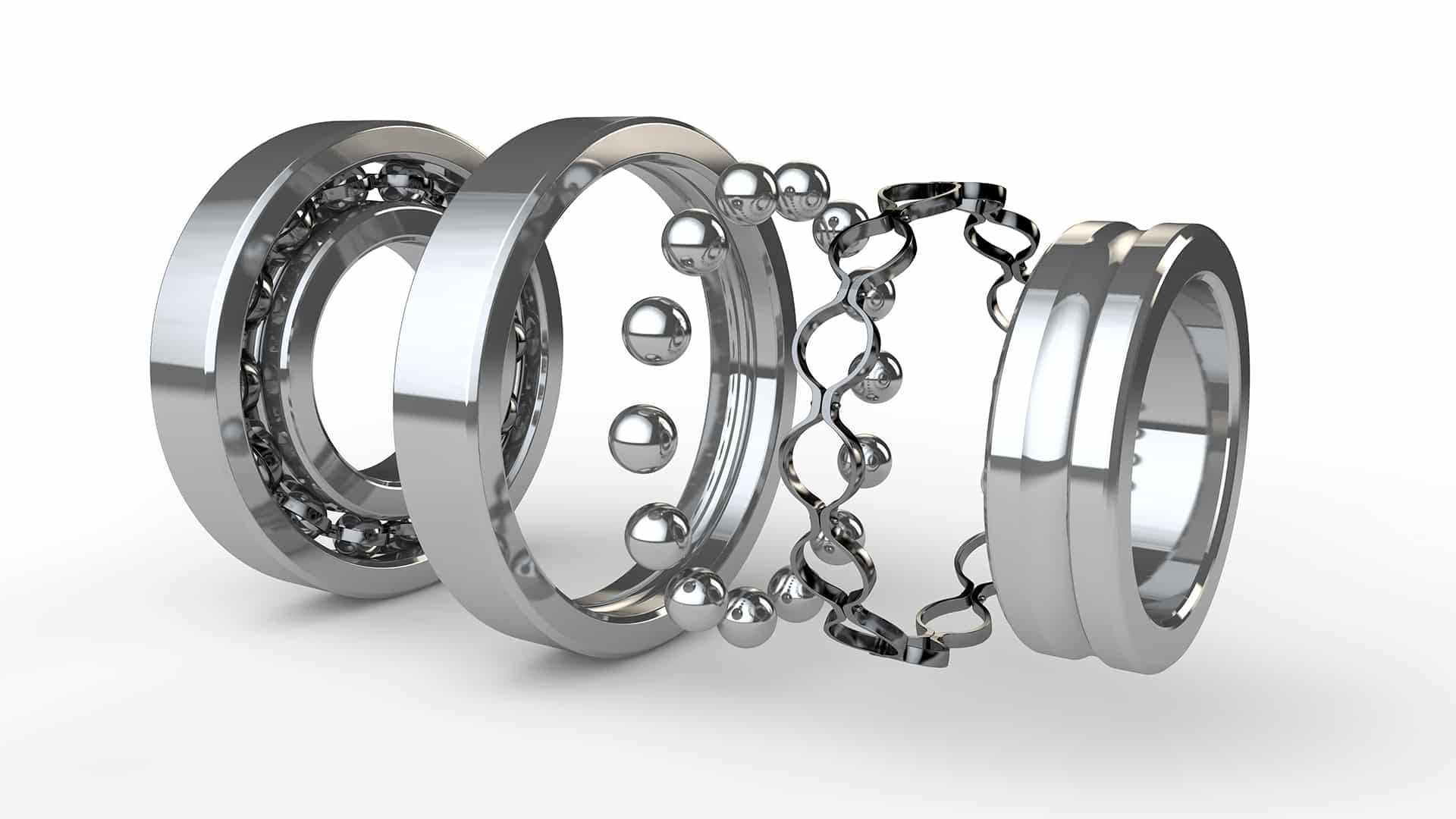
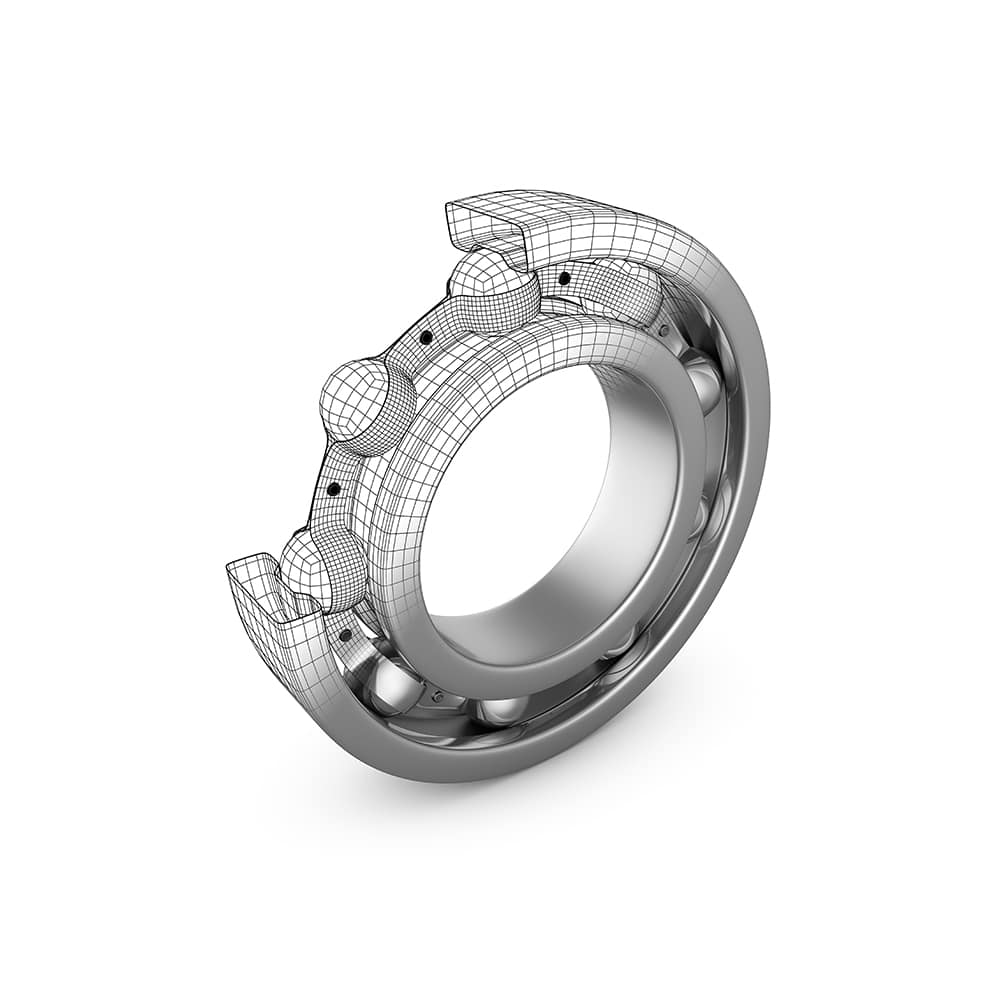
What Is a Deep-Groove Ball Bearing?
A single-row ball bearing with deep raceway grooves that support primarily radial loads and moderate axial loads in both directions. It offers low friction, high speed capability, and low noise.
Typical uses: conveyors, motors/gearmotors, pillow blocks, pumps, gearboxes, sealed units in packaging/washdown machinery.
Selection Cheatsheet (Washdown/Food)
If/Then Rules
- If frequent high‑pressure washdown (≥ 100 bar) or caustic/acidic cleaners, then use contact seals (2RS) or labyrinth + auxiliary external seal, stainless rings/balls where feasible, and H1 grease with cleaner compatibility data. Always conduct a clean water rinse to ensure caustic residue is removed from surfaces.
- If exposure to brine/sugar/particulates, then prefer hard, low‑roughness surfaces, enhanced sealing, and purgeable grease paths; plan shorter relube intervals.
- If temperature rise or interference fit reduces running clearance, then specify C3/C4 clearance appropriately; avoid over‑clearancing when temperatures are modest. Engineered thin dense chromium coatings can help avoid thermal shock and clearance requirements altogther.
Application → Attributes Matrix
| Application Trait | Recommended Ring Material | Clearance | Fit (Inner/Housing)* | Sealing | Grease |
| Daily hot‑water washdown | Stainless or coated steel rings | C3 | k5–m6 / H7 | 2RS + external deflector | H1, water‑resistant |
| Caustic/alkaline cleaners (CIP) | Coated steel rings | C3 | k5–m6 / H7 | 2RS | H1, EP + corrosion inhibitors |
| Brine/sugar exposure | Coated rings, stainless balls | C3 | k5–m6 / H7 | 2RS | H1, washout‑resistant |
| High‑speed small motors | Through‑hardened steel or coated rings | C0–C3 | k5–m6 / H7 | ZZ or low‑drag RS | H1, low bleed |
| Abrasive slurry/dust | Coated rings | C3 | k5–m6 / H7 | 2RS + slingers | H1, thickener for sealing |
*Fit guidance assumes rotating inner ring; adjust for your kinematics.
Common Failures & Diagnostics
Rapid Triage

1) Corrosion (pitting/crevice/rust staining)
Symptoms
Brown/red staining near seals, rough running, elevated noise after washdown cycles.
Likely clauses
Water/chemical ingress; inadequate post‑wash drying; cleaner pH/chemistry attacking steel; marginal grease film.
Checks
Seal condition and contact; ingress paths (shaft shoulders, housings); cleaner MSDS/compatibility; water jets aimed at seals.
Non-coating actions
Improve sealing (contact + deflectors), adjust washdown angles/pressures, select compatible H1 grease, add purge routine, consider stainless rings/balls.
When surface treatments help
Hard, inert chromium‑family surfaces that reduce corrosion initiation and crevice attack at raceways/shoulders.
Won’t solve
Chronic misalignment, loose fits that pump fluid in, underspecified seals.
2) Fretting / False Brinelling (standby vibration)
Symptoms
Reddish/black oxides, evenly spaced dents matching ball pitch, noise rising after shipping or idle periods.
Likely causes
Micro‑slip at raceway under vibration with inadequate film; loose fits.
Checks
Shaft/housing fit; transport vibration levels; preload; lubricant bleed.
Non-coating actions
Tighter fits or clamp, transportation locks, elastomer mounts, controlled preload; grease with good film persistence.
When surface treatments help
Nodular, micro‑textured hard chromium surfaces that resist micro‑welding and reduce oxide debris generation.
Won’t solve
Persistent large‑angle oscillation, misalignment.
3) Abrasive Wear / Contamination
Symptoms
Elevated torque, “dry” sound, accelerated seal wear, metallic debris in grease.
Causes
slurry, sugar crystals, flour dust, stainless flaking from upstream components.
Non-coating actions
double‑seals, slingers/labyrinths, shields over seals, better filtration, purge intervals.
Surface treatments
Hard, low‑roughness surfaces to reduce cutting; may extend life when combined with improved sealing. A combination of adequate lubrication and chromium coatings is highly effective at improving device performance.
4) Lubricant Breakdown / Water Washout
Symptoms
Grease bleeding, emulsified grease, torque spikes after cleaning.
Causes
Incompatible cleaners, high jet temperatures, wrong thickener.
Fixes
H1 grease verified vs. your cleaners; relube schedule post‑wash; consider food‑grade polymers on seals for chemical resistance.
5) Misalignment / Poor Fits
Symptoms
Edge stress spalling, hot running, rapid seal wear.
Fixes
correct housing machining, use self‑aligning bearings where misalignment is structural; verify fits/shoulders; coatings won’t fix this.
Surface Treatment Options (When & Why)
Apply coatings when they address a surface‑driven failure mechanism (corrosion, fretting, abrasion). Do not apply coatings as a substitute for proper fits, clearance, sealing, or alignment.
| Treatment (generic) | Mechanism | Pros | Trade‑offs | Best For | Not For |
| Thin Dense Chromium (nodular micro‑texture) | Hard, inert surface; nodular topography promotes film retention | Corrosion resistance, fretting resistance, low roughness, cleanability | Adds microns; check clearances; requires controlled deposition | Washdown corrosion, fretting at standby, abrasive fines | Fixing misalignment or poor fits |
| Electroless Nickel (Ni‑P, high‑P) | Amorphous corrosion‑resistant layer | Excellent uniformity; corrosion protection | Friction higher than bare steel; watch for wear focus* | Uniform coverage on complex parts | High‑speed minimal‑friction duty |
*For nickel solutions, position benefits around corrosion/cleanability, not “high wear” claims.
Integration Tips
Validate that added thickness preserves internal clearances and cage/seal running gaps.
Match ring/ball materials to avoid galvanic issues; ensure post‑treatments are food‑safe.
Fits, Tolerances & Clearance (Quick Rules)
-
Inner ring on rotating shaft: light interference (e.g., k5–m6) to prevent creep; avoid pumping paths for fluid.
-
Outer ring in stationary housing: H7 slip to ease assembly unless vibration justifies tighter fit.
-
Clearance: use C3 when temperature rise or interference will reduce running clearance; otherwise C0 may yield quieter operation. Avoid stacking tolerances that overshoot C4.
-
Thermal growth: stainless housings and shafts can change fits under hot water; confirm coefficients and transient spikes.
Checklist
-
Shoulder heights and chamfers compatible with bearing chamfers
-
Roundness/runout within bearing grade requirements
-
Seal compression consistent after coating thickness
Frequently Asked Questions
Often not. Stainless improves corrosion resistance but may still fail under aggressive cleaners and jetting; sealing, grease selection, and surface condition remain critical.
No. Coatings resist corrosion after ingress; you must first prevent ingress with sealing, fits, and washdown practices.
In direct spray zones, protection outranks drag. Use contact seals and mitigate torque via grease selection and correct preload/clearance.
Contact Armoloy
Have a failure photo, sound clip, or spec? Upload it and we’ll assess the issue and outline recommended next steps.
Request Information