
application insights
application insights
3D Suction Blow Molding
WHAT IS STRETCH BLOW MOLDING
Did You Know?
3D suction blow molding shapes complex, curved hollow parts—especially automotive air/charge‑air ducts and filler pipes—by first closing the mold, then drawing a molten parison through the 3D cavity with vacuum (often with support air to prevent collapse), followed by blowing and cooling to final geometry. This approach enables long, branched parts with reduced flash/scrap versus conventional routes.
At-A-Glance Facts:
- Also called: parison suction blow molding; 3D extrusion blow molding
- Typical where: automotive HVAC/engine air ducts, charge‑air/turbo pipes, filler necks; also some appliance and tubing parts
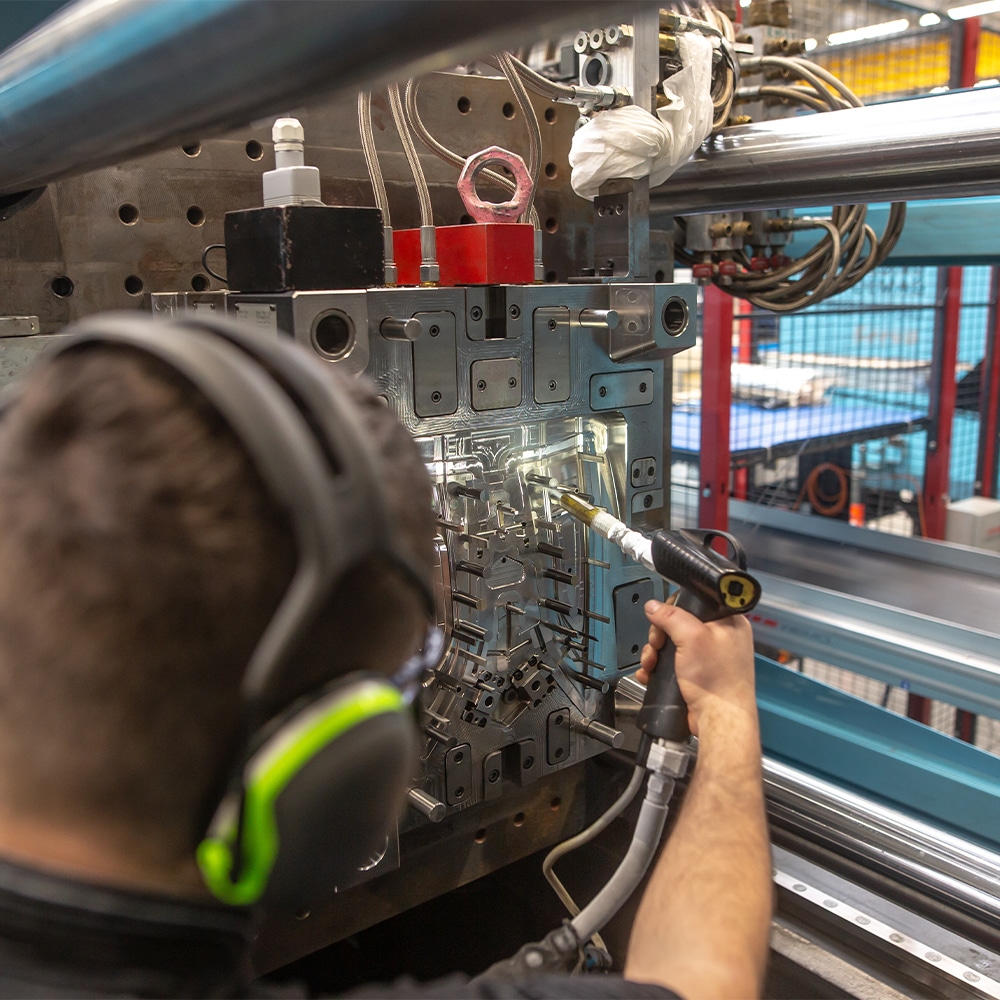
- Key machine elements: extruder + continuous or accumulator head, vacuum device/channels, support‑air and blow air, 3D mold with vents, pinch‑off/deflash
- Process options: Mono‑material or sequential multi‑material (dual‑resin) runs for localized properties

How It Works (typical sequence)
1. Mold closes to define the 3D path
2. A parison is extruded and sucked through the cavity using a vacuum device; support air inside the parison prevents collapse and helps guidance
3. Ends are pinched; blow air expands the parison against cavity walls; cooling fixes shape; ends are trimmed/deflashed
4. The suction phase positions the parison so much of the material lies within the cavity before inflation—reducing waste for long, narrow 3D parts compared with conventional EBM approaches
Typical Defects (and where they come from)
- Wall thinning at tight bends or near vacuum ports (positioning/flow related)
- Incomplete placement or wrinkling if suction/support‑air balance is off
- Seam/pinch‑off weaknesses if edge geometry or cooling are inadequate (visible as leaks at ends). (General to blow molding; mitigated by edge maintenance and cooling balance.)
Common metal/tooling challenges
Pinch‑off lands / knives: repeated hot parison contact → edge wear & galling
3D cavity surfaces near ports: abrasion with filled PA/PP; risk of vacuum‑port clogging
Die lips / mandrels: erosion/abrasion at high throughputs
Screw & barrel (upstream): abrasive/corrosive wear when running glass‑/mineral‑filled formulations
Surface Engineering Options
Siloed by what you’re seeing on the tool (symptoms) so you can choose the right surface solution.
Start with the question: did the metal fail, or is it failing?
In 3D suction blow molding, common symptoms like surface scuffing, sticking on suction/mandrel interfaces, wear on critical perimeters, and finish defects tied to heat or contamination are the bridge between performance issues and root cause.
Metal failures we target
- Sliding wear / scuffing on suction surfaces
- Galling in high-contact zones
- Edge wear / geometry loss on sealing features
- Corrosion / pitting (materials & resin chemistry dependent)
Performance failures we target
- Sticking / material pickup that disrupts cycles
- Surface finish defects (scuff, haze, marks)
- Short maintenance intervals / frequent cleaning
- Thermal-related quality issues (hot spots, seams)
Important: “Armoloy-available treatments” are what we provide. “Other industry options” are common alternatives that may be supplied by other providers.
| What you’re seeing (symptoms) | Likely failure mode | Armoloy-available treatments | Other industry options (not offered by Armoloy) | Benefit focus |
| Sticking or material pickup on suction tips, mandrel surfaces, or contact zones; inconsistent release | Friction + adhesion (material pickup) driven by surface roughness and chemistry | Electroless Nickel + PTFE (EN-PTFE) (where specified)
|
DLC (PVD/PACVD)
|
Performance failures
Sticking, cycle stability |
| Scuffing / sliding wear on mandrel edges, suction lips, or high-contact interfaces | Adhesive + sliding wear; often tied to high contact and cyclical motion | Thin Dense Chrome (TDC)
|
CrN (PVD)
|
Metal + performance
Wear mitigation / longer tool life |
| Edge wear on sealing lips, perimeters, or geometry that affects part definition | Abrasive wear and geometry loss on sharp/high-contact edges | Thin Dense Chrome (TDC)
|
Hard PVD films (e.g., CrN variants)
|
Metal failures
Wear mitigation / geometry retention |
| Corrosion marks, staining, or haze after cleaning/washdown; surfaces that trap contaminants | Corrosion initiation + roughness/buildup sites; chemistry and moisture accelerate attack | Electropolish + passivation (where applicable)
|
ASTM A967 passivation (industry standard process)
|
Metal + performance
Corrosion control & cleanliness |
| Thermal instability, hot spots, finish defects tied to temperature imbalance | Thermal management limitation (heat extraction and stability), not always solved by a coating alone | Surface engineering consult
|
High-conductivity copper alloys (e.g., MoldMAX® / AMPCOLOY®)
|
Performance failures
Quality stability / defect control |
How to use this section: Tell us the symptom, where it shows up (suction tips, mandrel surfaces, sealing/perimeter features), the resin/additives, and your dimensional constraints. We’ll validate the best Armoloy-available treatment—or point you to a proven industry alternative when that’s the better engineering call.