

Armoloy Specifications
Armoloy Specifications
ASTM E376
Standard Practice for Measuring Coating Thickness by Magnetic-Field or Eddy Current (Electromagnetic) Testing Methods
Armoloy Specifications
What is ASTM E376?
Purpose and Applications of ASTM E376
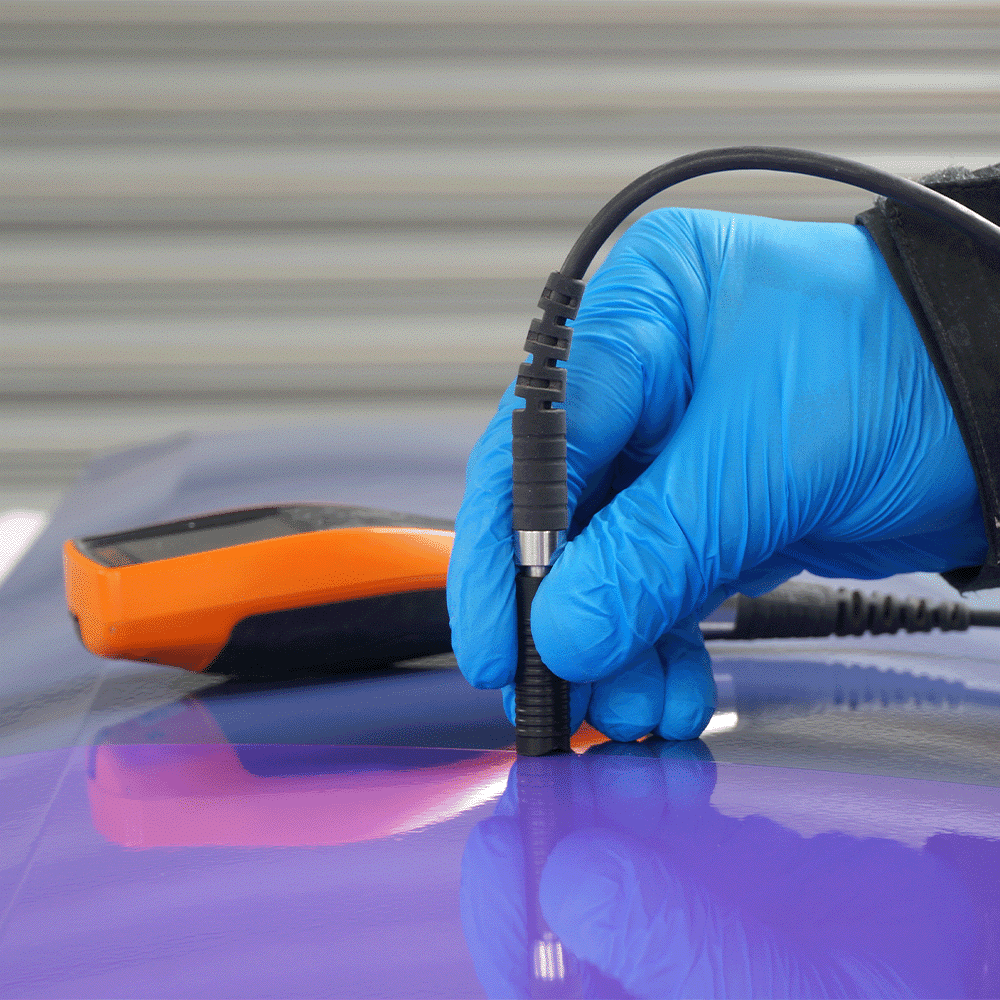
ASTM E376 serves as a guideline for selecting and using appropriate instruments to measure coating thickness without damaging the part. It is particularly useful in industries where precise coating measurements are essential for quality control and performance, including:
- Aerospace and Defense: Ensuring protective coatings meet stringent specifications.
- Automotive Manufacturing: Verifying paint and plating thickness for durability and aesthetics.
- Marine and Shipbuilding: Assessing corrosion-resistant coatings on hulls and components.
- Electronics: Measuring thin conductive or insulating layers on components.
- Construction: Evaluating protective coatings on structural steel.
ASTM E376 Testing Methodology
Magnetic Method
Magnetic-type gauges operate based on the magnetic attraction between a magnet and the substrate or the reluctance of a magnetic flux path through the coating and substrate. These gauges are designed to measure the thickness of nonmagnetic coatings on magnetic substrates (e.g., paint on steel).
Eddy Current Method
Eddy current-type gauges are electronic instruments that measure variations in impedance caused by coating thickness variations. They are suitable for measuring nonconductive coatings on nonmagnetic, conductive substrates (e.g., paint on aluminum).
Accuracy and Calibration
The accuracy of measurements depends on several factors:
- Instrument Calibration: Regular calibration against known standards is essential.
- Surface Conditions: Surface roughness, curvature, and cleanliness can affect readings.
- Material Properties: Variations in magnetic permeability and electrical conductivity of the substrate and coating.
Under ideal conditions, the measurement accuracy can be within ±10% of the actual coating thickness or ±2.5 µm (±0.0001 in.), whichever is greater.

Industries that Follow ASTM E376
- Aerospace & Defense: For verifying coating thickness on aircraft components and military equipment.
- Automotive Industry: Ensuring uniform paint and plating thickness on vehicles.
- Marine Industry: Assessing protective coatings on ships and offshore structures.
- Electronics Manufacturing: Measuring thin films and coatings on electronic devices.
- Construction and Infrastructure: Evaluating protective coatings on bridges, buildings, and pipelines.
Benefits of Working with an ASTM E376 Provider
Nondestructive testing
Allows for coating thickness measurement without damaging the part
Versatility
Applicable to a wide range of substrate and coating combinations
Compliance with international standards
Aligns with ISO 2178 requirements
Quality assurance
Ensures coatings meet specified thickness requirements for performance and durability
Contact Us
Armoloy offers plating solutions that meet both regulatory compliance and individual project needs. Contact us to find the right solution for your application.
Disclaimer
The information provided on this page, including any descriptions, interpretations, or summaries related to ASTM E376, is offered solely by The Armoloy Corporation for general informational purposes. This content reflects Armoloy’s internal understanding and practical application of ASTM E376 within its own processes and does not constitute official or authorized guidance from ASTM International.
ASTM E376 is a proprietary standard developed and owned by ASTM International. Armoloy makes no claim to ownership of this specification and does not reproduce, quote, or distribute any protected content from the original document. References to ASTM E376 are made in accordance with fair use principles and are intended to illustrate Armoloy’s alignment with widely recognized infrared temperature measurement practices.
This content is not intended to substitute for the official specification, which should be obtained directly from ASTM International. Readers are strongly encouraged to consult the original standard and qualified professionals for definitive technical or compliance information.
The Armoloy Corporation makes no warranties, express or implied, regarding the accuracy, completeness, or applicability of this content and disclaims all liability for any reliance placed upon it. This disclaimer is subject to change without notice and does not create any contractual relationship or obligation.